AI-Powered Threat Detection: The Future of Cyber security
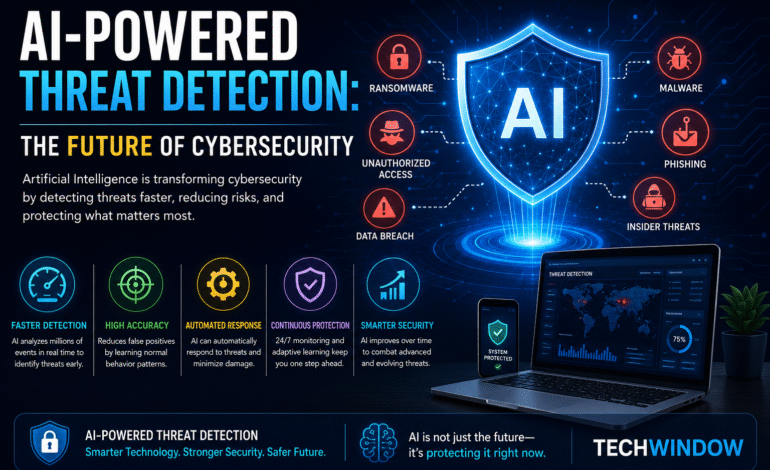

Cyber threats are becoming more and more dynamic. Everyday, businesses, governments, and individuals are hit by thousands of cyber attacks. Traditional security systems have a hard time keeping up with the changing tactics and strategies of cybercriminals.
This is where AI-powered threat detection is making a significant impact. Artificial Intelligence is transforming cybersecurity by helping organizations detect threats faster, respond more effectively, and prevent attacks before they cause damage.
Tech Window‘s comprehensive guide explores how AI-based threat detection functions, the advantages it offers, its current applications, challenges, and why it’s the future of cybersecurity.
Understanding AI-Powered Threat Detection
AI-powered threat detection involves using AI and Machine Learning tools to automatically detect, analyze and respond to cyber threats.
AI systems are not just about predefined rules and known threat signatures; they also learn from data, detect anomalies, and adjust to emerging attack techniques.
This is where AI proves to be especially effective against modern cyber threats that are typically able to navigate around traditional security frameworks.
AI-powered threat detection can help identify:
- Malware attacks
- Ransomware infections
- Phishing attempts
- Insider threats
- Network intrusions
- Data breaches
- Account compromise attempts
One of the most significant benefits of an AI-powered cybersecurity solution is its ability to identify both familiar and unfamiliar attacks.
Why Traditional Cybersecurity Is Struggling
Cybersecurity tools have been based on signature-based detection for many years.
This approach is to compare files and activities with a database of known threats. It is effective against known malware but it has a few restrictions.
Modern cybercriminals use techniques such as:
- Polymorphic malware
- Fileless attacks
- Zero-day exploits
- Social engineering attacks
- Advanced persistent threats (APTs)
These attacks can alter their behavior and evade normal detection techniques.
This means that organizations have to adopt more intelligent security tools that are able to analyze behavior instead of just relying on known signatures.
AI provides exactly that capability.
How AI-Powered Threat Detection Works
Advanced algorithms power AI threat detection systems to continuously track the network, users, devices, and applications.
Typically, it goes through multiple phases.
Data Collection
The first step is collecting data from various sources.
These sources include:
- Network traffic
- Endpoints and devices
- User activities
- Cloud environments
- Applications
- Security logs
AI systems analyze vast amounts of data that are too large and complex for human manual analysis.
Machine Learning Analysis
Machine Learning algorithms analyse the collected data and detect patterns.
The system learns:
- Normal user behavior
- Standard network activity
- Regular access patterns
- Typical application usage
As time goes by, AI establishes a normal baseline of actions.
Behavioral Monitoring
Once the normal activity patterns have been established, AI can continuously monitor for anomalies.
Examples include:
- Logins from unusual locations
- Unexpected file transfers
- Sudden increases in network traffic
- Unauthorized access attempts
These anomalies may indicate a potential cyber attack.
Threat Detection and Classification
If suspicious activity is identified, AI assesses the threat.
The system analyzes:
- Severity level
- Potential impact
- Probability of malicious intent
AI can categorise threats and prioritise them by risk.
This assists security staff to prioritize the most essential problems initially.
Automated Response
There are multiple platforms that can respond automatically with AI.
Possible actions include:
- Blocking malicious IP addresses
- Isolating infected devices
- Disabling compromised accounts
- Alerting security teams
This rapid response reduces the time attackers have to exploit systems.
Key Technologies Behind AI-Powered Security
AI threat detection is possible with several advanced technologies.
Artificial Intelligence
With AI, systems can make intelligent decisions using a vast amount of data.
It enables detection of threats which traditional systems may not detect.
Machine Learning
With machine learning, systems can learn and adapt over time.
The more data is analyzed, the better the threat detection.
Deep Learning
Deep Learning techniques rely on intricate neural networks that uncover intricate patterns in extensive data sets.
This enhances the accuracy of detection of advanced cyber threats.
Behavioral Analytics
Behavioral analytics is based on user and device behaviour.
It can detect unusual actions that could signal malicious activity.
Threat Intelligence Integration
Global threat intelligence feeds can be integrated into AI systems.
It allows the detection of new attacking strategies before they become common.
Benefits of AI-Powered Threat Detection
Organizations are adopting AI security solutions because of the significant advantages they offer.
Faster Threat Detection
AI can analyze millions of security events within seconds.
This is a considerable decrease in detection times.
Real-Time Protection
Security reviews are usually done after a security incident.
AI offers a real-time threat identification and continuous monitoring solution.
Reduced False Positives
There is often a lot of time spent by security teams on investigating meaningless alerts.
By analyzing context and behavior, AI enhances accuracy.
This will minimize unnecessary alerts.
Better Scalability
As organizations expand, their security data will likewise expand.As organizations grow, so will their security data.
As the amount of information grows, AI systems can process more information without a drop in performance.
Enhanced Incident Response
AI can aid security teams in their response to threats more quickly and effectively.
Human error can be minimized during incidents by automation.
Real-World Applications of AI Threat Detection
AI-powered cybersecurity is being used across multiple industries.
Financial Services
Banks use AI to:
- Detect fraudulent transactions
- Monitor suspicious activities
- Protect customer accounts
AI helps prevent financial losses and improves fraud detection accuracy.
Healthcare
Healthcare organizations use AI to protect:
- Patient records
- Medical devices
- Healthcare networks
This helps maintain privacy and regulatory compliance.
E-Commerce
Online retailers use AI to:
- Detect payment fraud
- Prevent account takeovers
- Protect customer information
AI improves transaction security and customer trust.
Government Agencies
Government organizations use AI for:
- National security
- Infrastructure protection
- Cyber threat intelligence
AI helps defend critical systems against sophisticated attacks.
Challenges of AI-Powered Threat Detection
Although AI offers many benefits, there are also challenges.
Implementation Costs
Implementing advanced AI cybersecurity solutions can be an expensive venture.
Adopting can be difficult for small organisations.
Data Privacy Concerns
AI systems tend to process vast amounts of user data.
Organizations should ensure that they comply with privacy rules.
AI-Powered Cyber Attacks
Cybercriminals are also leveraging AI.
Examples include:
- AI-generated phishing emails
- Deepfake attacks
- Automated hacking tools
Security teams need to stay one step ahead of attackers’ new technologies.
Dependence on Data Quality
AI systems are only as good as the data they analyze.
Poor-quality data can reduce detection accuracy.
Future Trends in AI-Powered Threat Detection
AI will play a pivotal role in the future of cybersecurity.
The industry is anticipated to be influenced by several new trends.
Predictive Security
AI will no longer be limited to threat detection and begin predicting attacks before they happen.
The proactive approach will aid in bolstering security.
Autonomous Security Systems
Future AI systems will automatically identify, evaluate, and react to threats with little human involvement.
Enhanced Cloud Security
AI is going to be a key player in the security of cloud systems as more organizations turn to the cloud.
Advanced Threat Intelligence
AI will process global threat intelligence data faster and more effectively.
This will improve early threat detection capabilities.
Zero Trust Security Integration
AI will be a tool that aids Zero Trust security models as they continually monitor user and device behavior.
Why AI Is the Future of Cybersecurity
The volume and complexity of cyber threats continue to increase.
Organizations face challenges such as:
- Limited cybersecurity talent
- Growing attack surfaces
- Sophisticated threat actors
- Rapid digital transformation
AI helps address these challenges by providing:
- Faster threat detection
- Real-time monitoring
- Automated response capabilities
- Improved threat intelligence
As technology evolves, AI-powered threat detection will become a standard component of cybersecurity strategies worldwide.
Conclusion
AI-powered threat detection is revolutionizing cybersecurity. The power of AI, Machine Learning, Behavioral Analytics, and Automation enables organizations to identify threats at an early stage and safeguard their critical systems more effectively.
AI is not a replacement for cybersecurity professionals but rather a powerful force multiplier that aids in mitigating risks and strengthening security operations.
We know at Tech Window that threat detection is the future of cyber security and that it is now powered by AI. AI-powered security investments now will help to better secure against cyber threats of the future.