AI-Driven Cyber Threats: The Next Frontier of Digital Risk
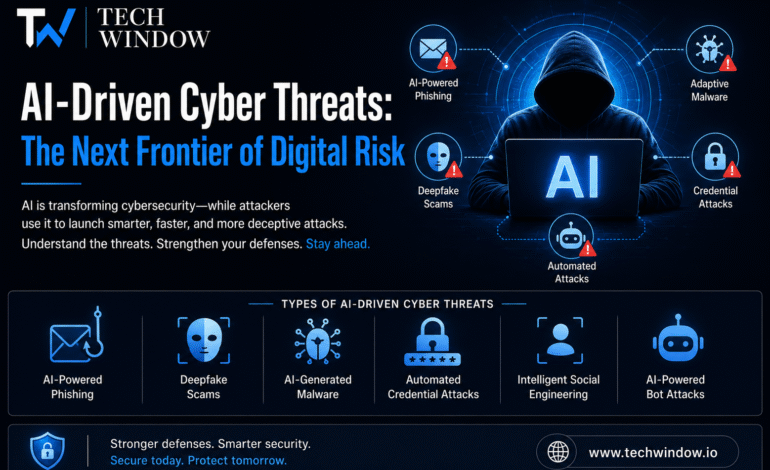

Cybersecurity has entered a new era. As Artificial Intelligence (AI) continues to transform industries, cybercriminals are also leveraging AI to launch more sophisticated, scalable, and difficult-to-detect attacks. While AI offers significant benefits for threat detection and security automation, it has also become a powerful weapon in the hands of attackers.
From AI-generated phishing emails to deepfake scams and automated malware, AI-driven cyber threats are rapidly becoming one of the biggest digital risks facing individuals and organizations in 2026.
In this comprehensive guide by Tech Window, we’ll explore what AI-driven cyber threats are, how they work, the risks they pose, and how businesses can defend against this emerging cybersecurity challenge.
What Are AI-Driven Cyber Threats?
AI-driven cyber threats are cyberattacks that use Artificial Intelligence, Machine Learning, or automation technologies to improve their effectiveness, speed, and ability to evade detection.
Unlike traditional cyberattacks, AI-powered attacks can:
- Learn from target behavior
- Adapt to security defenses
- Automate attack processes
- Generate realistic fake content
- Scale attacks across multiple targets
These capabilities make AI-driven threats more dangerous than many conventional cyberattacks.
Why AI Is Changing the Cyber Threat Landscape
Cybercriminals are constantly seeking new ways to exploit vulnerabilities.
AI gives attackers several advantages:
Faster Attack Execution
AI can automate repetitive attack tasks and execute them at scale.
Improved Accuracy
Machine learning helps attackers identify valuable targets more efficiently.
Better Evasion Techniques
AI can modify attack patterns to avoid traditional security systems.
Personalized Attacks
AI can analyze publicly available information to create highly convincing phishing campaigns.
As a result, organizations face a rapidly evolving threat environment.
Types of AI-Driven Cyber Threats
AI-Powered Phishing Attacks
Phishing remains one of the most successful cyberattack methods.
AI makes phishing more dangerous by generating highly personalized messages.
Modern AI phishing campaigns can:
- Mimic writing styles
- Personalize emails
- Create convincing fake websites
- Generate realistic chat conversations
Victims often struggle to distinguish these messages from legitimate communications.
Deepfake Scams
Deepfake technology uses AI to create realistic audio, video, and image content.
Cybercriminals use deepfakes to:
- Impersonate executives
- Commit financial fraud
- Manipulate employees
- Spread misinformation
Deepfake attacks have become increasingly sophisticated and difficult to detect.
AI-Generated Malware
Traditional malware often relies on static code.
AI-powered malware can:
- Adapt its behavior
- Avoid detection
- Modify attack methods
- Learn from security responses
This makes it harder for traditional antivirus solutions to identify malicious activity.
Automated Credential Attacks
AI can analyze user behavior and automate attempts to gain access to accounts.
Examples include:
- Credential stuffing
- Password guessing
- Account takeover attacks
Machine learning improves the efficiency of these attacks.
Intelligent Social Engineering
Social engineering attacks manipulate human behavior.
AI enables attackers to:
- Analyze social media profiles
- Understand communication habits
- Create convincing fake identities
This increases the success rate of scams.
AI-Powered Bot Attacks
Modern bots are becoming increasingly intelligent.
AI-driven bots can:
- Mimic human behavior
- Bypass security controls
- Automate fraud attempts
- Scrape sensitive information
Many organizations struggle to distinguish these bots from legitimate users.
Real-World Examples of AI Cyber Risks
Several emerging cyber risks demonstrate the growing impact of AI.
Executive Impersonation
Attackers use AI-generated voices to impersonate company executives and request fraudulent payments.
Deepfake Recruitment Fraud
Cybercriminals use deepfake technology during online interviews to gain access to sensitive systems.
Automated Phishing Campaigns
AI tools generate thousands of personalized phishing emails in minutes.
AI-Assisted Vulnerability Discovery
Attackers use AI to identify weaknesses in software and networks more quickly.
These examples highlight the increasing sophistication of cyber threats.
Why Traditional Security Measures Are Struggling
Many traditional cybersecurity solutions rely on:
- Signature-based detection
- Fixed security rules
- Manual monitoring
AI-driven attacks often bypass these defenses because they constantly evolve.
Traditional systems may struggle to identify:
- Unknown attack patterns
- Behavioral anomalies
- Deepfake content
- Adaptive malware
Organizations need more advanced defenses to keep pace with AI-powered threats.
How AI Is Also Fighting AI Threats
Fortunately, cybersecurity professionals are using AI to defend against AI-powered attacks.
AI security solutions help organizations:
Detect Threats Faster
AI analyzes millions of security events in real time.
Identify Behavioral Anomalies
Machine learning detects unusual user and device behavior.
Improve Incident Response
AI automates threat investigation and containment.
Reduce False Positives
Security teams receive more accurate alerts.
This creates an ongoing battle between defensive AI and offensive AI.
Industries Most at Risk
Financial Services
Banks and payment providers face fraud, phishing, and account takeover attacks.
Healthcare
Healthcare organizations manage highly sensitive patient information.
Government Agencies
Critical infrastructure and public services remain attractive targets.
E-Commerce
Online retailers face payment fraud and account compromise attempts.
Technology Companies
Tech organizations often store valuable intellectual property and customer data.
How Organizations Can Defend Against AI-Driven Threats
Implement AI-Powered Security Solutions
Modern security platforms use AI to detect emerging threats.
Adopt Zero Trust Security
Zero Trust reduces the risk of unauthorized access.
Every user and device must be continuously verified.
Strengthen Employee Training
Employees should learn how to identify:
- Phishing emails
- Deepfake scams
- Social engineering attacks
Human awareness remains critical.
Enable Multi-Factor Authentication (MFA)
MFA adds an additional security layer beyond passwords
Monitor User Behavior
Behavioral analytics helps identify suspicious activity early.
Regularly Update Systems
Software updates help close vulnerabilities that attackers may exploit.
The Future of AI-Driven Cyber Threats
The next few years are expected to bring even more advanced AI threats.
Key trends include:
Autonomous Attack Systems
AI may launch and manage attacks with minimal human involvement.
More Realistic Deepfakes
Deepfake technology will continue improving.
AI-Powered Reconnaissance
Attackers will use AI to gather intelligence on targets more efficiently.
Adaptive Malware
Future malware may continuously modify itself to evade detection.
Increased Attack Automation
Cybercriminals will automate larger portions of the attack lifecycle.
Organizations must prepare for this evolving threat landscape.
AI-Driven Threats vs Traditional Cyber Threats
| Feature | Traditional Threats | AI-Driven Threats |
| Speed | Moderate | Extremely Fast |
| Personalization | Limited | Highly Personalized |
| Adaptability | Low | High |
| Automation | Partial | Extensive |
| Detection Difficulty | Moderate | High |
| Scalability | Limited | Massive |
Conclusion
AI-driven cyber threats represent the next frontier of digital risk. As cybercriminals increasingly use Artificial Intelligence to automate attacks, create deepfakes, develop adaptive malware, and launch sophisticated phishing campaigns, organizations must strengthen their cybersecurity defenses.
The same technology powering innovation can also be used to exploit vulnerabilities. This makes proactive security strategies more important than ever.
At Tech Window, we believe that understanding AI-driven cyber threats is essential for businesses and individuals looking to stay protected in an increasingly AI-powered world. By combining advanced security technologies, employee awareness, and modern cybersecurity frameworks, organizations can better defend against the next generation of digital threats.