


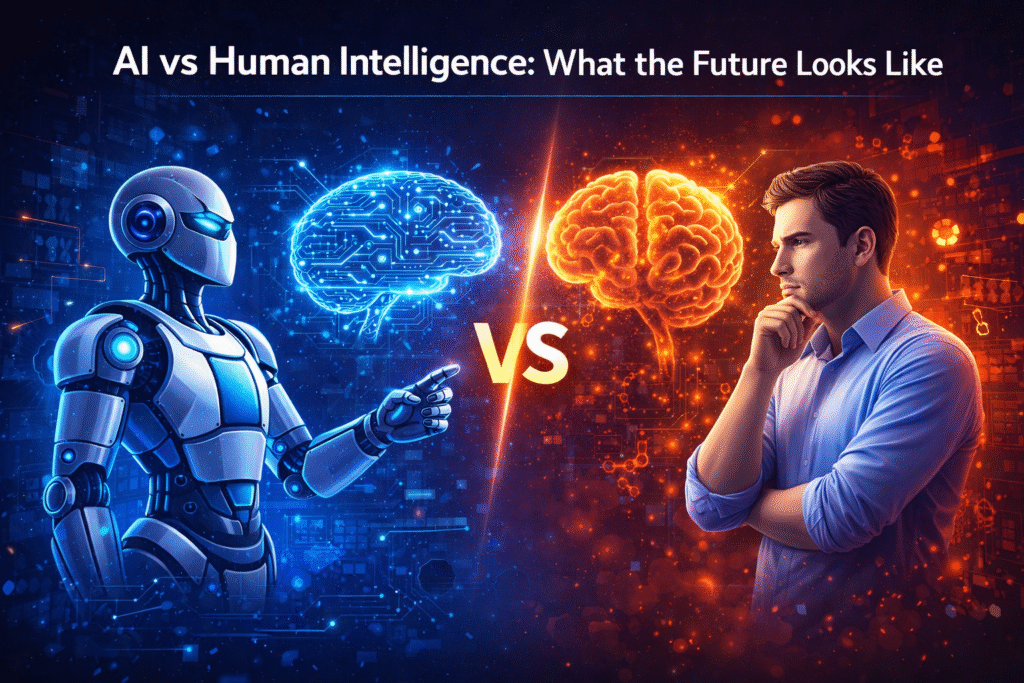
Artificial Intelligence is growing rapidly. From chatbots to self-driving cars, AI is becoming a part of everyday life. At the same time, human intelligence remains unique and powerful.
This raises an important question: Can AI replace human intelligence? Or will both work together in the future?
In this article by Tech Window, we explore the key differences between AI and human intelligence and what the future may look like.
What Is Artificial Intelligence?
Artificial Intelligence (AI) refers to machines that can perform tasks that usually require human thinking. These tasks include learning, problem-solving, decision-making, and understanding language.
Popular AI tools such as:
- ChatGPT
- Google Gemini
- Claude
are capable of generating content, answering questions, and assisting with complex tasks.
AI works by analyzing large amounts of data and identifying patterns. It can process information much faster than humans.
What Is Human Intelligence?
Human intelligence is natural. It involves reasoning, emotions, creativity, and the ability to adapt to new situations.
Unlike AI, humans can:
- Feel emotions
- Think creatively
- Make ethical decisions
- Understand complex social situations
Human intelligence is shaped by experiences, learning, and emotions. This makes it flexible and deeply personal.
Key Differences Between AI and Human Intelligence
1. Speed and Efficiency
AI can process large amounts of data in seconds. It can perform repetitive tasks quickly and accurately.
Humans are slower in comparison. However, humans can understand context better and make thoughtful decisions.
2. Creativity
AI can generate content based on patterns. It can write articles, create images, and even compose music.
But human creativity is original. Humans can think outside the box and create something completely new.
3. Emotions and Understanding
AI does not have emotions. It can simulate human-like responses but cannot truly feel.
Humans, on the other hand, understand emotions deeply. This helps in building relationships and making moral decisions.
4. Learning Ability
AI learns from data and training models. It improves based on the information it receives.
Humans learn from experiences, mistakes, and real-life situations. This makes human learning more adaptable.
5. Decision Making
AI makes decisions based on data and algorithms. It follows logic and patterns.
Humans consider emotions, ethics, and values while making decisions. This makes human judgment more balanced in complex situations.
Will AI Replace Humans?
The idea of AI replacing humans is a common concern. However, the reality is more balanced.
AI is designed to assist humans, not completely replace them.
AI is excellent at:
- Data analysis
- Automation
- Repetitive tasks
- Predictive modeling
Humans are better at:
- Creativity
- Emotional intelligence
- Leadership
- Critical thinking
In most cases, AI will work with humans, not against them.
The Future: Collaboration Between AI and Humans
The future will likely be a combination of AI and human intelligence working together.
For example:
- AI can analyze data, while humans make strategic decisions
- AI can generate content, while humans refine and personalize it
- AI can automate tasks, while humans focus on creativity and innovation
This collaboration will improve productivity and create new opportunities across industries.
Impact on Jobs and Careers
AI is changing the job market. Some jobs may be automated, but new roles are also being created.
Future jobs will require:
- Digital skills
- AI understanding
- Creativity
- Problem-solving abilities
People who adapt to new technologies will have better career opportunities.
Learning how to use AI tools can give you a strong advantage in the future job market.
Final Thoughts
AI and human intelligence are both powerful in different ways. AI offers speed, efficiency, and automation. Human intelligence provides creativity, emotion, and critical thinking.
Instead of competing, the future will focus on collaboration between the two.
At Tech Window, we believe that understanding AI and learning how to use it effectively is the key to success in the digital age.The future is not about AI vs humans. It is about AI + humans working together.


