


In today’s digital landscape, Artificial Intelligence (AI) is becoming a game-changer in various sectors, and cybersecurity is no exception. With the growing sophistication of cyber threats, traditional security systems are sometimes unable to follow. That’s where artificial intelligence-based security can help.
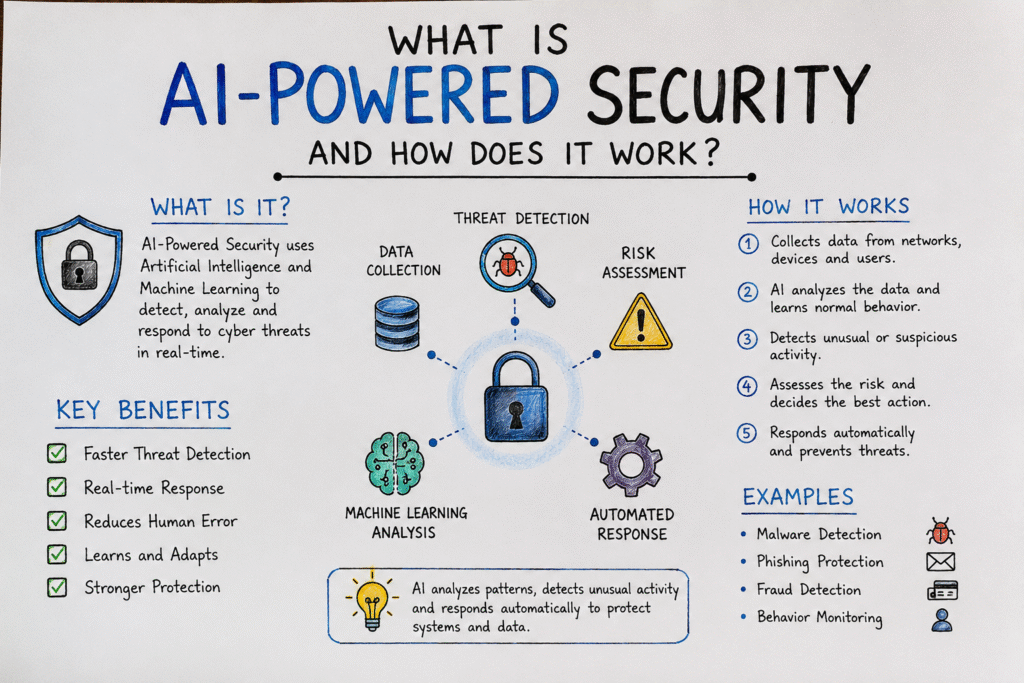
AI-powered security is security solutions that are based on the Artificial Intelligence and Machine Learning technologies, enabling the automatic detection, analysis, and response to cyber threats. It enables organizations to detect suspicious activity quicker and boost its security stance.
In this guide from Tech Window, we will discuss the concept of AI in security, its benefits, the challenges it faces, and why it is crucial for 2026.
What Is AI-Powered Security?
AI-based security involves utilizing AI technology to safeguard digital systems, networks, devices, and data against cyber threats.
AI systems can learn, identify patterns, and flag suspicious activities in real time, as opposed to traditional security systems that are based on pre-established rules.
AI-powered security solutions help organizations:
- Identify and identify cyber threats sooner.
- Prevent data breaches
- Automate threat responses
- Improve security monitoring
- Reduce human errors
These systems continually learn and adapt to new attack methods.
Why Traditional Security Is No Longer Enough
Cybercriminals are constantly developing new attack techniques.
Traditional security systems often depend on:
- Known malware signatures
- Fixed security rules
- Manual threat analysis
These are still effective techniques but they might not be able to identify the latest and unknown dangers.
Modern cyber attacks can:
- Change their behavior
- Avoid detection by traditional methods
- Propagate quickly on network(s)
AI can address these challenges by detecting activities that could be suspicious signs of a cyber attack.
How Does AI-Powered Security Work?
AI-powered security operates by gathering and processing massive amounts of security data.
Usually contains multiple steps.
1. Data Collection
AI systems gather information from multiple sources, including:
- Network traffic
- User activity
- Login records
- Applications
- Endpoints
- Cloud environments
The AI system can identify patterns the more data it has.
2. Machine Learning Analysis
Data collected is analyzed by Machine Learning algorithms.
They learn:
- Normal user behavior
- Typical network activity
- Standard access patterns
Once the system understands normal behavior, it can identify unusual activities.
For example:
- Unexpected login attempts
- Large data transfers
- Access from unfamiliar locations
These events may indicate a security threat.
3. Threat Detection
AI continuously monitors systems for suspicious behavior.
It can detect:
- Malware
- Phishing attacks
- Ransomware
- Insider threats
- Unauthorized access
AI can often detect threats which have never occurred in the past, unlike regular systems.
4. Risk Assessment
When a threat is detected, AI evaluates its severity.
The system determines:
- Potential impact
- Level of risk
- Recommended actions
This assists security teams in prioritising threats.
5. Automated Response
Many AI-powered security platforms can respond automatically.
Common responses include:
- Blocking bad IP addresses.
- Isolating infected devices
- Disabling compromised accounts
- Alerting security teams
Implementation of automation saves response time and limits damage.
Key Technologies Behind AI-Powered Security
AI-enabled security is the result of a combination of technologies.
Artificial Intelligence
AI can provide simulated human decision-making and the ability to detect complex threats.
Machine Learning
Machine Learning enables systems to learn from data and get better with time.
Behavioral Analytics
Behavioral analysis is based on the user’s behavior and detects any abnormal behavior.
Natural Language Processing (NLP)
NLP can be used to analyze emails, messages, and documents to detect phishing and malicious content.
Threat Intelligence
AI brings together threat intelligence information from around the world to keep you up to date with the latest cyber threats.
Benefits of AI-Powered Security
AI-powered security offers several advantages over traditional methods.
Faster Threat Detection
AI can handle millions of security events within seconds.
This enables the organizations to reach a quick finding on the threats.
Reduced Human Workload
Security teams typically receive thousands of alerts every day.
Alerts are processed by AI which filters and prioritizes, saving manual effort.
Improved Accuracy
AI helps to minimize false positives.
This reduces security resources’ time spent on benign activities.
24/7 Monitoring
AI systems run 24/7 without downtime.
They can offer protection 24 hours a day.
Better Protection Against Advanced Threats
AI can identify unknown attack patterns and emerging cyber threats.
This makes it effective against modern cyber attacks.
Real-World Applications of AI Security
Many industries employ AI-powered security.
Banking and Finance
Banks use AI to:
- Detect fraud
- Monitor transactions
- Prevent account takeovers
Healthcare
AI is essential in safeguarding patient information and medical records for healthcare providers.
E-Commerce
AI is being applied in online businesses for detecting fraudulent transactions and safeguarding customer data.
Enterprise Security
Large organizations rely on AI for:
- Network monitoring
- Threat detection
- Incident response
Challenges of AI-Powered Security
While AI offers many benefits, it also has limitations.
High Implementation Costs
Advanced AI security solutions can be expensive.
Data Quality Requirements
AI systems require large amounts of accurate data.
Poor-quality data can reduce effectiveness.
Privacy Concerns
Extensive monitoring may raise privacy issues.
Organizations must balance security with user privacy.
Evolving Threats
Cybercriminals are also using AI to create more advanced attacks.
This creates an ongoing security challenge.
The Future of AI-Powered Security
AI is expected to play an even larger role in cybersecurity.
Future developments may include:
- Fully automated threat response
- Predictive threat detection
- Advanced fraud prevention
- AI-powered security operations centers
- Smarter cloud security systems
As cyber threats continue to evolve, AI will become an essential part of digital defense strategies.
AI-Powered Security vs Traditional Security
| Feature | Traditional Security | AI-Powered Security |
|---|---|---|
| Threat Detection | Rule-based | Behavior-based |
| Speed | Moderate | Real-time |
| Learning Ability | Limited | Continuous learning |
| Automation | Low | High |
| Unknown Threat Detection | Difficult | Strong |
Final Thoughts
AI-powered security is revolutionizing cybersecurity in 2026. By combining Artificial Intelligence, Machine Learning, and automation, organizations can detect threats faster, respond more effectively, and protect valuable data.
While AI is not a complete replacement for human security experts, it is becoming one of the most powerful tools available for defending against modern cyber threats.
At Tech Window, we believe understanding AI-powered security is essential for anyone interested in technology, online safety, and the future of cybersecurity.


