


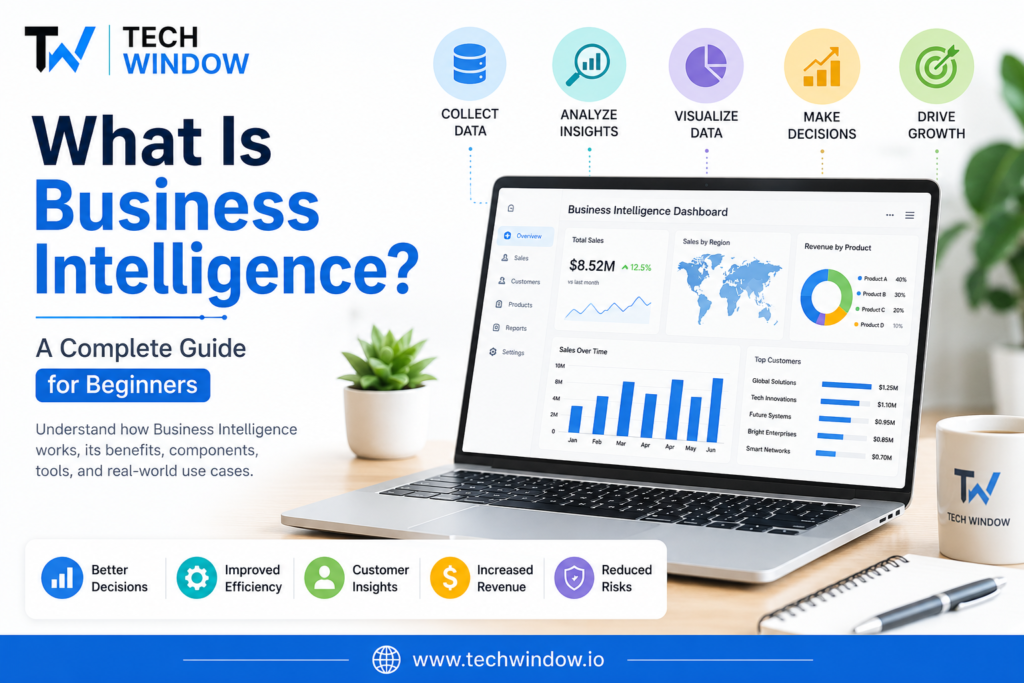
In the current digital era, companies generate tons of data on a daily basis. Whether it’s data from customer interactions, sales reports, website analytics, or marketing campaigns, there’s more data for organizations to access than ever before. However, collecting data is only the first step. It’s all about data, and how they can utilize it to make informed business decisions.
This is where Business Intelligence (BI) comes into play.
With Business Intelligence, organizations can convert raw data into valuable insights that can be used for strategic planning, efficiency and growth. Business Intelligence is essential in today’s business world and it is important for both students and other business professionals as well as entrepreneurs.
This complete Business Intelligence guide by Tech Window will provide an understanding of what Business Intelligence is, how it functions, the components of BI, benefits of Business Intelligence, challenges, and why BI is a necessary part of today’s data-driven economy.
What Is Business Intelligence?
Business Intelligence (BI) is a collection of technologies, processes and tools that are used to gather, analyse and present data of a business for it to make informed decisions.
Business Intelligence basically enables companies to respond to vital queries like:
- What are our best-selling products?
- What are the areas of success in marketing campaigns?
- What can we do to lower our expenses?
- What’s the current trend in the market?
- What can be done to make customers happier?
By converting complex data into easy-to-understand reports and dashboards, BI enables businesses to make smarter decisions based on facts rather than assumptions.
Why Is Business Intelligence Important?
In today’s business world, there is a lot of competition. Without good data, good decisions can be missed and bad decisions can be made on a huge budget.
Business Intelligence helps organizations:
- Improve decision-making
- Identify growth opportunities
- Increase operational efficiency
- Monitor business performance
- Understand customer behavior
- Reduce business risks
Companies that effectively use BI often gain a significant competitive advantage.
How Does Business Intelligence Work?
Business Intelligence is a systematic process of converting raw data into meaningful information.
1. Data Collection
Organizations collect information from several sources such as:
Websites
- Sales systems
- Customer relationship management (CRM) software
- Websites
- Social media platforms
- Financial systems
- Marketing tools
2. Data Integration
All collected data is compiled in a central collection (data warehouse).
This guarantees uniformity and makes it easier to use.
3. Data Analysis
BI tools look at the data and find patterns, trends and relationships.
4. Data Visualization
Information is conveyed using:
- Dashboards
- Charts
- Graphs
- Reports
- Scorecards
When data is complex, a visual representation helps to make it easier to understand.
5. Decision-Making
These insights help business people make strategic and operational decisions.
Key Components of Business Intelligence
Data Warehousing
A data warehouse is a large collection of business data that is structured in a single place.
Data Mining
Data mining looks for patterns and relationships in data sets.
Reporting
Reports give a summary of business performance and important measures.
Dashboards
A dashboard is like a window into business operations that displays real-time information.
Analytics
Low code platforms enable organizations to gain insight and make predictions.
Performance Management
Business success is measured by BI systems, which monitor key performance indicators (KPIs).
Types of Business Intelligence
Descriptive Analytics
Answers the question:
“What happened?”
This could be monthly sales reports, website traffic summaries, or anything else you can think of.
Diagnostic Analytics
Answers:
“Why did it happen?”
This helps businesses understand causes behind specific outcomes.
Predictive Analytics
Answers:
“What is likely to happen next?”
Machine learning and statistical models are often used.
Prescriptive Analytics
Answers:
“What should we do?”
This type of analysis provides recommendations for decision-making.
Benefits of Business Intelligence
Better Decision-Making
BI provides accurate information that supports smarter business decisions.
Increased Efficiency
Organizations can identify inefficiencies and optimize processes.
Improved Customer Insights
Businesses gain a deeper understanding of customer needs and behaviors.
Higher Revenue
Data-driven strategies often lead to increased sales and profitability.
Competitive Advantage
Companies can respond faster to market changes and emerging trends.
Real-Time Monitoring
Dashboards provide instant visibility into business performance.
Business Intelligence Use Cases
Sales Analysis
Organizations monitor the performance of sales and discover sales opportunities.
Marketing Optimization
Marketing teams analyze campaign performance and customer engagement.
Financial Management
Finance departments monitor budgets, expenses, and profitability.
Supply Chain Management
Savings for businesses in terms of inventory management and operational efficiency.
Customer Service
BI can be used to pinpoint customer complaints and enhance satisfaction.
Human Resources
BI is utilized to analyze the performance of the workforce and the trends in recruitment.
Popular Business Intelligence Tools
There are multiple BI platforms that can assist companies in the analysis and visualization of data.
Popular examples include:
- Microsoft Power BI
- Tableau
- Qlik Sense
- SAP BusinessObjects
- IBM Cognos Analytics
- Looker
These tools provide dashboards, reporting capabilities, and advanced analytics features.
Business Intelligence vs Business Analytics
| Feature | Business Intelligence | Business Analytics |
|---|---|---|
| Focus | Historical Data | Future Predictions |
| Purpose | Reporting & Monitoring | Advanced Analysis |
| Approach | What Happened? | What Will Happen? |
| Users | Managers & Executives | Data Analysts & Scientists |
Both Business Intelligence (BI) and
Business Analytics (BA) play important roles in modern organizations.
While BI focuses on understanding historical performance and monitoring business operations,
BA helps organizations predict future outcomes and make data-driven strategic decisions.
Challenges of Business Intelligence
Data Quality Issues
Poor-quality data can produce inaccurate insights.
Integration Complexity
It can be challenging to combine the data from multiple systems.
Security Concerns
Businesses have to safeguard sensitive business data.
High Implementation Costs
There are some BI solutions that demand big investments.
User Adoption
Training can be required for staff on how to use BI tools.
The Future of Business Intelligence
Business Intelligence is still a growing industry that is developing new technologies.
Key trends include:
AI-Powered Analytics
Artificial Intelligence assists with automating data analysis and insight generation.
Self-Service BI
Reports can be created without technical skills on the user.
Real-Time Analytics
Instant visibility for organisations in the business operations.
Cloud-Based BI
Cloud platforms have the ability to enhance accessibility and scalability.
Predictive Intelligence
More precise predictions and suggestions will be given through advanced analytics.
Best Practices for Business Intelligence Success
Organizations should:
- Define clear business goals
- Maintain high-quality data
- Select the appropriate BI tools for the job.
- Train employees effectively
- Key in on actionable insights.
- Continuously monitor performance
By doing so, businesses can make the best use of their investments in BI.
Conclusion
In today’s organizations, Business Intelligence is one of the most helpful technologies. BI can turn raw data into valuable insights, which can help businesses make better decisions, boost efficiency, better the customer experience, and drive long-term growth.
As data becomes more and more crucial, companies that dedicate in Business Intelligence will be better positioned to contend in a significantly more advanced and information driven universe.
At Tech Window, we believe Business Intelligence is no longer optional—it’s a critical tool for organizations looking to unlock the full potential of their data.


