


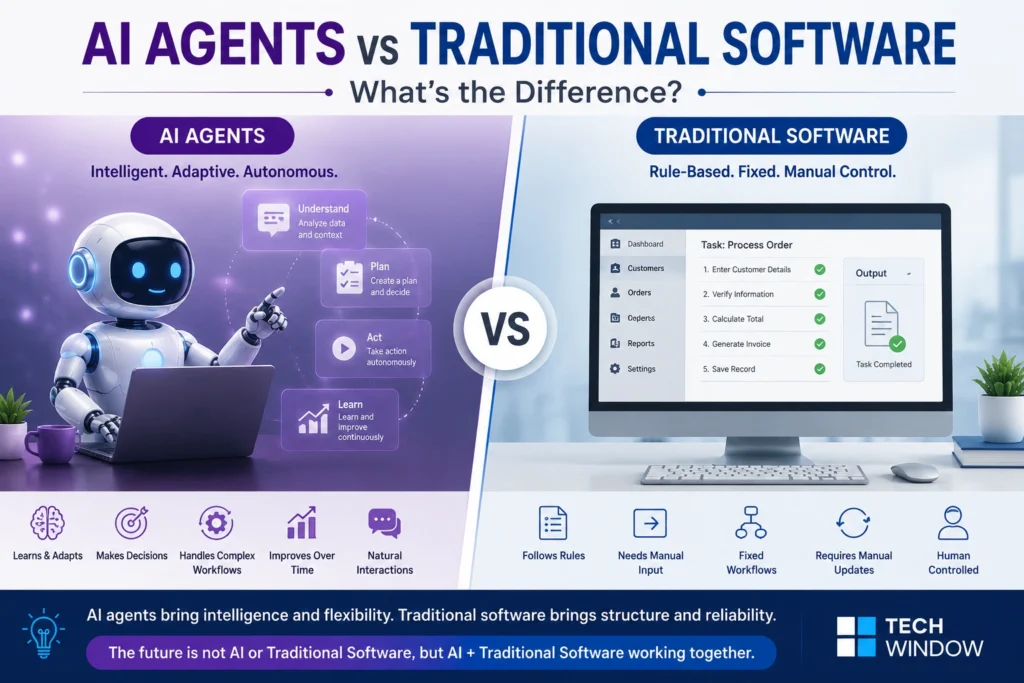
The impact of Artificial Intelligence on Business is transforming them rapidly. AI-powered solutions are increasingly becoming a staple in today’s modern organizations, from streamlining customer support to managing complex workflows. One of the most significant advancements in the past few years has been the emergence of AI Agents, which are intelligent systems designed to carry out tasks, make decisions, and adapt to various conditions with minimum human intervention.
While all that, traditional software still runs most of the business processes across the globe. Resources like Customer Relationship Management (CRM) systems, accounting software, project management tools and enterprise resource planning (ERP) platforms are still essential for daily business operations.
A key question that arises is:
How are AI agents different from traditional software?
Both technologies can help to increase efficiency and productivity for organizations, but they work in very different ways. By understanding these nuances, companies can make more informed decisions in their technology choices and plan for what lies ahead in the digital transformation landscape.
In this Tech Window guide, we will discuss what an AI agent is, the differences between AI agents and traditional software, the advantages and disadvantages of each, and the potential future of both types of software.
What Is Traditional Software?
Traditional software refers to applications designed to perform specific tasks using predefined rules and instructions written by developers.
These programs follow fixed workflows and execute actions exactly as they have been programmed.
Examples include:
- Accounting software
- Payroll systems
- Inventory management tools
- CRM platforms
- Project management applications
- Spreadsheet software
Traditional software operates within clearly defined boundaries and generally requires users to provide structured inputs to generate expected outputs.
Characteristics of Traditional Software
Traditional software is typically:
- Rule-based
- Predictable
- Process-oriented
- Structured
- Human-controlled
It performs well in environments where tasks and processes remain consistent over time.
What Are AI Agents?
AI Agents are intelligent software systems capable of understanding goals, making decisions, learning from information, and taking actions autonomously.
Unlike traditional software, AI agents are not limited to fixed instructions.
They can:
- Analyze information
- Understand context
- Learn from interactions
- Adapt to changing situations
- Execute multi-step tasks
AI agents often use technologies such as:
- Artificial Intelligence
- Machine Learning
- Natural Language Processing (NLP)
- Large Language Models (LLMs)
- Automation platforms
Examples include:
- AI customer support assistants
- Virtual workplace assistants
- AI research agents
- Autonomous sales agents
- Workflow automation agents
These systems are increasingly being used to improve productivity and streamline business operations.
For more information about the AI Agensts e, you can visit:
AI Agents in Business
The Future of Work: Humans and AI Working Together
How Traditional Software Works
Traditional software relies on predefined programming logic.
For example:
If a customer submits a form:
- The software validates the input.
- The data is stored in a database.
- A confirmation message is sent.
Every step follows instructions created by developers.
If a new requirement emerges, developers must manually update the software.
Traditional applications generally do not learn or improve independently.
How AI Agents Work
AI agents function differently.
Instead of following only fixed rules, they focus on achieving objectives.
For example, an AI customer support agent can:
- Understand customer questions
- Search internal knowledge bases
- Generate responses
- Escalate complex issues
- Learn from previous interactions
Rather than following a single predefined path, the agent dynamically determines the best course of action based on available information.
This flexibility makes AI agents more adaptable than traditional software.
AI Agents vs Traditional Software: Key Differences
Decision-Making
Traditional software follows predefined rules.
AI agents evaluate information and make context-aware decisions.
Learning Ability
Traditional software does not learn from experience.
AI agents can improve their performance using machine learning and historical data.
Adaptability
Traditional systems require manual updates when business requirements change.
AI agents can adapt to new situations and changing inputs.
User Interaction
Traditional software often requires structured inputs such as forms and menus.
AI agents support conversational interactions through natural language.
Automation Scope
Traditional software automates specific tasks.
AI agents can automate entire workflows involving multiple steps and decisions.
Problem Solving
Known scenarios are dealt with in a traditional way in software.
AI agents can evaluate new scenarios and create responses on the fly.
AI Agents vs Traditional Software Comparison
| Feature | Traditional Software | AI Agents |
| Operation | Rule-Based | Goal-Oriented |
| Learning Ability | None | Continuous Learning |
| Adaptability | Limited | High |
| Decision-Making | Fixed Rules | Context-Aware |
| User Interaction | Structured Inputs | Natural Language |
| Automation | Task-Based | Workflow-Based |
| Problem Solving | Predictable | Dynamic |
| Scalability | Moderate | High |
| Personalization | Limited | Advanced |
| Intelligence | Predefined Logic | AI-Powered |
This comparison highlights why AI agents are becoming increasingly attractive for organizations seeking greater flexibility and automation.
Advantages of Traditional Software
Despite the rise of AI, traditional software remains highly valuable.
Reliability
Traditional systems provide predictable outputs.
Easier Compliance
Fixed workflows simplify auditing and regulatory compliance.
Lower Complexity
Businesses can implement and maintain traditional software more easily.
Proven Performance
Many organizations have relied on traditional applications for decades.
Cost Efficiency
For simple tasks, traditional software may remain the most practical option.
Advantages of AI Agents
AI agents offer several benefits beyond conventional software capabilities.
Increased Productivity
They automate repetitive and complex activities.
Better Customer Experiences
AI agents provide personalized interactions and faster responses.
Continuous Improvement
Learning capabilities help AI agents improve over time.
Smarter Decision-Making
They analyze large amounts of data and generate actionable insights.
Enhanced Scalability
AI agents can handle growing workloads with minimal additional resources.
These advantages are driving widespread adoption across industries.
Real-World Applications of AI Agents
Customer Support
AI agents can:
- Answer questions
- Resolve common issues
- Route tickets
- Provide 24/7 assistance
Sales and Marketing
Organizations use AI agents to:
- Qualify leads
- Analyze customer behavior
- Generate personalized recommendations
Human Resources
AI assists with:
- Candidate screening
- Employee onboarding
- Workforce analytics
Cybersecurity
Security teams use AI agents for:
- Threat detection
- Incident response
- Risk monitoring
Business Operations
AI agents streamline workflows and automate administrative tasks.
Challenges of AI Agents
While powerful, AI agents are not perfect.
Data Privacy Risks
Organizations must protect sensitive information used by AI systems.
Accuracy Issues
AI-generated outputs may occasionally contain errors.
Regulatory Compliance
Businesses must ensure AI usage aligns with industry regulations.
Ethical Concerns
Bias, transparency, and accountability remain important considerations.
Implementation Costs
Deploying advanced AI solutions may require significant investment.
Organizations should establish strong governance practices when adopting AI agents.
Will AI Agents Replace Traditional Software?
The answer is likely no.
Instead, AI agents and traditional software will coexist and complement one another.
Traditional software remains ideal for:
- Fixed workflows
- Regulatory environments
- Transaction processing
- Structured operations
AI agents excel in:
- Adaptive decision-making
- Complex workflows
- Personalized interactions
- Intelligent automation
Most organizations will adopt a hybrid technology model that combines both approaches.
The Future of Software
The software industry is entering a new era.
Several trends are expected to shape the future:
Autonomous AI Agents
Future systems will perform increasingly complex tasks independently.
Multi-Agent Collaboration
Multiple AI agents may work together to achieve business objectives.
Intelligent Business Platforms
Enterprise software will become more adaptive and AI-driven.
Human-AI Collaboration
Employees will increasingly work alongside AI systems rather than being replaced by them.
Hyper-Personalized Experiences
AI agents will deliver highly customized services and recommendations.
Businesses that embrace these technologies will gain significant competitive advantages.
AI Agents and Human Workers
One common concern is whether AI agents will replace human employees.
In reality, AI agents are more likely to augment human capabilities than eliminate jobs entirely.
Humans continue to provide:
- Creativity
- Leadership
- Strategic thinking
- Emotional intelligence
- Ethical judgment
AI agents handle repetitive, data-intensive, and time-consuming tasks.
Together, they create a more productive and innovative workplace.
Conclusion
AI agents and traditional software represent two different approaches to solving business challenges. Traditional software relies on fixed rules and structured processes, while AI agents introduce intelligence, adaptability, and autonomous decision-making.
Rather than replacing traditional software, AI agents are enhancing how organizations operate by automating workflows, improving customer experiences, and enabling smarter decision-making.
As businesses continue their digital transformation journeys, understanding the differences between AI agents and traditional software will become increasingly important.
At Tech Window, we believe the future belongs to organizations that successfully combine the reliability of traditional software with the intelligence and flexibility of AI-powered agents.


