


As cyber threats continue to evolve, traditional security systems are finding it increasingly difficult to keep pace with sophisticated attacks. Organizations now face ransomware, phishing campaigns, data breaches, insider threats, and advanced persistent threats on a daily basis. To address these growing challenges, businesses are turning to Artificial Intelligence (AI) as a powerful tool for strengthening cybersecurity.
AI is transforming the way organizations detect, prevent, and respond to cyber threats. By analyzing massive amounts of data in real time, AI-powered security solutions can identify suspicious activities faster than traditional systems and help security teams protect critical assets more effectively.
In this guide by Tech Window, we’ll explore the role of Artificial Intelligence in modern cybersecurity, its benefits, applications, challenges, and future impact.
What Is Artificial Intelligence in Cybersecurity?
Artificial Intelligence in cybersecurity refers to the use of intelligent algorithms and machine learning technologies to identify, analyze, and respond to cyber threats automatically.
Unlike traditional security systems that rely primarily on predefined rules, AI can learn from data, recognize patterns, and adapt to new attack methods.
AI-powered cybersecurity solutions help organizations:
- Detect threats faster
- Reduce response times
- Improve threat intelligence
- Automate security operations
- Strengthen overall cyber defense
As cybercriminals become more sophisticated, AI has become an essential part of modern security strategies.
Why Modern Cybersecurity Needs AI
The digital world generates enormous amounts of data every second.
Security teams must monitor:
- Networks
- Devices
- Applications
- Cloud platforms
- User activities
Manually analyzing this information is nearly impossible.
AI helps solve this problem by:
- Processing large datasets instantly
- Identifying suspicious patterns
- Detecting hidden threats
- Reducing human workload
This allows organizations to respond to attacks before significant damage occurs.
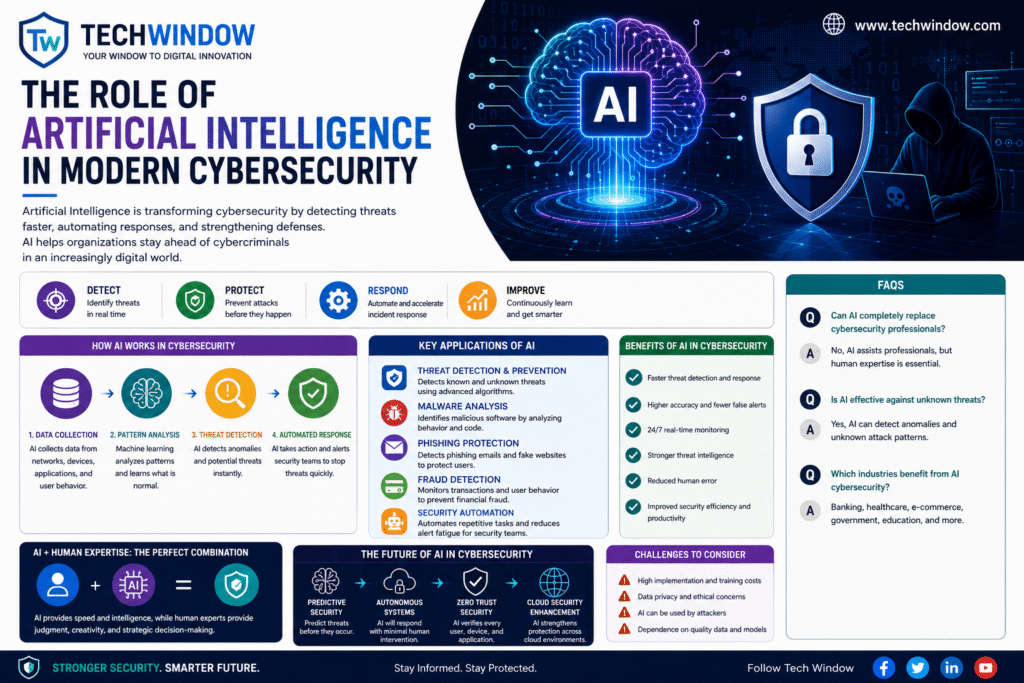
How AI Works in Cybersecurity
AI cybersecurity systems follow several important steps.
Data Collection
AI gathers information from multiple sources, including:
- Security logs
- Network traffic
- User activities
- Cloud environments
- Endpoint devices
The more data available, the more accurate threat detection becomes.
Pattern Recognition
Machine learning algorithms study data and establish a baseline of normal behavior.
For example:
- Normal login times
- Typical network usage
- Standard application activity
Once normal behavior is understood, AI can detect unusual activities.
Threat Detection
AI continuously monitors systems for anomalies.
Examples include:
- Unauthorized access attempts
- Suspicious file downloads
- Unusual login locations
- Unexpected network traffic spikes
These anomalies may indicate a cyber attack.
Automated Response
Many AI-powered systems can take immediate action.
Examples include:
- Blocking malicious IP addresses
- Isolating infected devices
- Disabling compromised accounts
- Sending alerts to security teams
This rapid response helps reduce damage.
Key Applications of AI in Cybersecurity
Threat Detection and Prevention
AI helps identify both known and unknown threats.
Unlike traditional systems that rely on signatures, AI can detect suspicious behavior even if the attack has never been seen before.
Malware Detection
Modern malware constantly evolves.
AI analyzes file behavior and system activities to identify malicious software before it spreads.
This helps protect systems against:
- Viruses
- Trojans
- Worms
- Spyware
Phishing Protection
Phishing remains one of the most common cyber threats.
AI can analyze:
- Email content
- Sender behavior
- Website characteristics
This helps identify phishing attempts before users become victims.
Fraud Detection
Financial institutions use AI to monitor transactions and identify suspicious behavior.
AI can detect:
- Unusual spending patterns
- Account takeovers
- Payment fraud
This improves customer protection and reduces financial losses.
Endpoint Security
AI protects devices such as:
- Laptops
- Smartphones
- Servers
- Workstations
It continuously monitors endpoints for suspicious activities and potential threats.
Security Operations Automation
Security teams often face thousands of alerts daily.
AI helps by:
- Prioritizing alerts
- Reducing false positives
- Automating repetitive tasks
This improves efficiency and allows analysts to focus on critical threats.
Benefits of AI in Modern Cybersecurity
Faster Threat Detection
AI can analyze millions of events within seconds.
This dramatically reduces detection times.
Improved Accuracy
Traditional security tools often generate false alarms.
AI evaluates context and behavior, improving detection accuracy.
Real-Time Monitoring
AI provides continuous protection 24/7.
It never gets tired and constantly monitors systems for threats.
Better Threat Intelligence
AI can analyze global threat data and identify emerging attack patterns.
This helps organizations stay ahead of cybercriminals.
Reduced Human Error
Human mistakes are one of the leading causes of security incidents.
AI helps automate critical security processes and reduce errors.
AI and Machine Learning in Cybersecurity
Machine Learning is one of the most important components of AI security systems.
Machine Learning allows systems to:
- Learn from previous attacks
- Improve detection accuracy
- Adapt to changing threats
- Identify hidden attack patterns
Over time, machine learning models become smarter and more effective.
Challenges of AI in Cybersecurity
Although AI offers many advantages, it is not without challenges.
High Implementation Costs
Advanced AI security solutions may require significant investment.
Small businesses may face budget constraints.
Data Privacy Concerns
AI systems often analyze large volumes of user data.
Organizations must ensure compliance with privacy regulations.
AI-Powered Cyber Attacks
Cybercriminals are also using AI.
They can create:
- Advanced phishing campaigns
- Deepfake scams
- Automated attack tools
This creates a cybersecurity arms race.
Dependence on Data Quality
AI systems require accurate and relevant data.
Poor-quality data can reduce effectiveness and increase errors.
Industries Benefiting from AI Cybersecurity
Banking and Finance
Banks use AI to detect fraud and secure customer accounts.
Healthcare
Healthcare providers use AI to protect sensitive patient information.
E-Commerce
Online businesses use AI to prevent fraud and secure payment systems.
Government
Government agencies use AI to defend critical infrastructure and national security systems.
Education
Educational institutions use AI to protect student records and digital learning platforms.
Future of AI in Cybersecurity
The role of AI in cybersecurity will continue to grow.
Future trends include:
Predictive Security
AI will predict threats before attacks occur.
Autonomous Security Systems
Future systems will automatically detect and respond to threats with minimal human intervention.
Advanced Threat Intelligence
AI will process global threat data faster and provide more accurate security insights.
Zero Trust Security
AI will play a key role in verifying users, devices, and applications continuously.
Cloud Security Enhancement
As cloud adoption increases, AI will become critical for protecting cloud environments.
Frequently Asked Questions (FAQs)
1. What is AI in cybersecurity?
AI in cybersecurity refers to the use of Artificial Intelligence and Machine Learning technologies to detect, analyze, and respond to cyber threats automatically.
2. How does AI improve cybersecurity?
AI improves cybersecurity by detecting threats faster, automating security processes, and identifying suspicious behavior in real time.
3. Can AI prevent cyber attacks?
AI can help prevent many cyber attacks by identifying risks early and responding quickly, but it cannot eliminate all threats.
4. What are the benefits of AI-powered cybersecurity?
Benefits include faster threat detection, improved accuracy, real-time monitoring, reduced human error, and enhanced threat intelligence.
5. Can hackers use AI?
Yes. Cybercriminals can use AI to create sophisticated phishing attacks, malware, and automated hacking tools.
6. Is AI replacing cybersecurity professionals?
No. AI assists security teams by automating tasks and improving detection capabilities, but human expertise remains essential.
7. Which industries use AI cybersecurity solutions?
Banking, healthcare, e-commerce, government, education, and many other industries use AI-powered security solutions.
8. What is the future of AI in cybersecurity?
The future includes predictive threat detection, autonomous security systems, stronger cloud security, and advanced threat intelligence.
Best Practices for Using AI in Cybersecurity
Organizations should:
- Combine AI with human expertise
- Continuously update AI models
- Monitor AI performance
- Invest in employee cybersecurity training
- Maintain strong data governance policies
AI works best when combined with skilled security professionals.
Conclusion
Artificial Intelligence is revolutionizing modern cybersecurity. From real-time threat detection and malware prevention to fraud detection and automated incident response, AI provides organizations with powerful tools to defend against increasingly sophisticated cyber threats.
While AI is not a complete replacement for human cybersecurity experts, it significantly improves security operations and helps organizations respond faster to attacks. At Tech Window, we believe that Artificial Intelligence will continue to shape the future of cybersecurity, helping businesses and individuals build stronger defenses in an increasingly connected world.


