


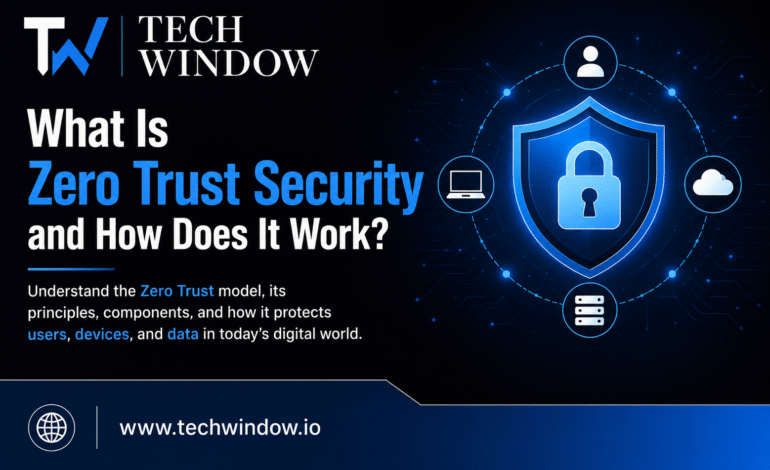
What Is Zero Trust Security and How Does It Work?

As cyber threats continue to grow in complexity, traditional security models are becoming less effective. Organizations can no longer assume that users, devices, or applications inside their network are automatically trustworthy. Modern cyber attacks often exploit trusted systems and compromised credentials to gain access to sensitive information.
This is why many organizations are adopting Zero Trust Security, a modern cybersecurity approach designed to protect digital assets in today’s highly connected world.
In this comprehensive guide by Tech Window, you’ll learn what Zero Trust Security is, how it works, its key principles, benefits, challenges, and why it is becoming a critical cybersecurity strategy in 2026.
What Is Zero Trust Security?
Zero Trust Security is a cybersecurity framework based on one simple principle:
“Never Trust, Always Verify.”
Unlike traditional security models that automatically trust users and devices within a network, Zero Trust assumes that every access request could be a potential threat.
This means:
- No user is trusted automatically.
- No device is trusted automatically.
- Every access request must be verified.
- Continuous monitoring is required.
Zero Trust focuses on protecting data, applications, users, and devices regardless of their location.
Why Traditional Security Models Are No Longer Enough
Traditional security relies on a perimeter-based approach.
Once users enter the network, they are often granted broad access.
This model worked when:
- Employees worked in offices.
- Applications were hosted on-premises.
- Devices were managed internally.
Today’s environment is different.
Organizations now use:
- Cloud computing
- Remote work
- Mobile devices
- Third-party applications
- Hybrid networks
Cybercriminals can exploit weak credentials and move freely within traditional networks.
Zero Trust eliminates this assumption of trust.
How Does Zero Trust Security Work?
Zero Trust Security continuously verifies every user, device, and application before granting access.
The process typically involves several layers of security.
1. Verify Identity
Every user must prove their identity before accessing resources.
Methods include:
- Strong passwords
- Multi-Factor Authentication (MFA)
- Biometric verification
- Single Sign-On (SSO)
Identity verification is the foundation of Zero Trust.
2. Validate Devices
Devices requesting access must meet security requirements.
Examples include:
- Updated operating systems
- Security patches installed
- Antivirus protection enabled
- Device compliance checks
Untrusted devices may be denied access.
3. Least Privilege Access
Users receive only the permissions necessary to perform their tasks.
This principle is called:
Least Privilege Access
Benefits include:
- Reduced attack surface
- Lower insider threat risks
- Improved data protection
Even if an account is compromised, attackers gain limited access.
4. Continuous Monitoring
Zero Trust continuously monitors activity after access is granted.
Security systems analyze:
- User behavior
- Login locations
- Device status
- Network activity
Suspicious behavior triggers alerts or blocks access automatically.
5. Micro-Segmentation
Micro-segmentation divides networks into smaller security zones.
This prevents attackers from moving freely across systems.
If one area is compromised, other areas remain protected.
Core Principles of Zero Trust Security
Successful Zero Trust implementations rely on several key principles.
Never Trust, Always Verify
Every request must be authenticated and authorized.
No exceptions.
Assume Breach
Organizations operate under the assumption that attackers may already be inside the network.
Security controls are designed accordingly.
Least Privilege Access
Users only receive the minimum access necessary.
Continuous Verification
Verification is ongoing rather than a one-time event.
Device Security
Every connected device must meet security standards.
Key Components of a Zero Trust Architecture
A Zero Trust environment typically includes:
Identity and Access Management (IAM)
Controls user authentication and authorization.
Multi-Factor Authentication (MFA)
Adds additional security layers beyond passwords.
Endpoint Security
Protects laptops, smartphones, servers, and other devices.
Network Segmentation
Separates systems into smaller protected zones.
Security Analytics
Uses AI and machine learning to detect suspicious behavior.
Data Protection
Protects sensitive information through encryption and access controls.
Benefits of Zero Trust Security
Organizations are increasingly adopting Zero Trust because of its numerous advantages.
Improved Data Protection
Zero Trust reduces unauthorized access to sensitive information.
Stronger Protection Against Cyber Attacks
Continuous verification makes it harder for attackers to move within networks.
Better Support for Remote Work
Employees can securely access resources from any location.
Reduced Insider Threats
Access controls limit the damage caused by compromised or malicious accounts.
Enhanced Regulatory Compliance
Zero Trust helps organizations meet data protection and privacy requirements.
Better Visibility
Security teams gain greater insight into users, devices, and network activities.
Zero Trust Security vs Traditional Security
| Feature | Traditional Security | Zero Trust Security |
| Trust Model | Trust Inside Network | Trust No One |
| Access Control | Broad Access | Least Privilege |
| Monitoring | Limited | Continuous |
| Threat Protection | Perimeter-Based | Identity-Based |
| Remote Work Security | Limited | Strong |
| Breach Prevention | Reactive | Proactive |
Real-World Applications of Zero Trust Security
Financial Institutions
Banks use Zero Trust to protect customer accounts and financial transactions.
Healthcare Organizations
Hospitals use Zero Trust to secure patient records and medical systems.
Government Agencies
Government organizations protect critical infrastructure using Zero Trust principles.
E-Commerce Platforms
Online businesses use Zero Trust to secure payment systems and customer data.
Enterprises
Large organizations use Zero Trust to secure hybrid work environments and cloud applications.
Challenges of Implementing Zero Trust
While Zero Trust offers significant benefits, implementation can be challenging.
High Initial Costs
Organizations may need to invest in new security technologies.
Complex Deployment
Implementing Zero Trust requires careful planning and architecture changes.
Legacy Systems
Older systems may not support modern Zero Trust requirements.
User Experience Concerns
Additional verification steps can sometimes impact convenience.
The Future of Zero Trust Security
Zero Trust is becoming a core cybersecurity strategy worldwide.
Future developments include:
AI-Powered Access Decisions
Artificial Intelligence will help evaluate risk levels in real time.
Automated Threat Response
Security systems will automatically respond to suspicious activities.
Enhanced Cloud Security
Zero Trust will play a critical role in securing cloud environments.
Integration with AI Cybersecurity
Organizations will combine Zero Trust frameworks with AI-powered threat detection.
Frequently Asked Questions (FAQs)
1. What is Zero Trust Security?
Zero Trust Security is a cybersecurity framework that requires continuous verification of users, devices, and applications before granting access.
2. What is the main principle of Zero Trust?
The core principle is “Never Trust, Always Verify.”
3. Why is Zero Trust important?
It helps protect organizations from modern cyber threats, insider risks, and unauthorized access.
4. Does Zero Trust replace traditional security?
No. It enhances traditional security by adding stronger identity verification and access controls.
5. What is least privilege access?
It means users receive only the permissions necessary to perform their tasks.
6. Is Zero Trust suitable for small businesses?
Yes. Small businesses can benefit from stronger access controls and improved protection against cyber attacks.
7. How does Multi-Factor Authentication support Zero Trust?
MFA verifies user identity through multiple authentication factors, reducing the risk of compromised accounts.
8. What is the future of Zero Trust Security?
The future includes AI-powered access management, automated security responses, and deeper cloud security integration.
Best Practices for Adopting Zero Trust
Organizations should:
- Implement Multi-Factor Authentication
- Apply least privilege access policies
- Monitor users continuously
- Secure endpoints and devices
- Encrypt sensitive data
- Segment networks effectively
- Use AI-powered security tools
These practices strengthen Zero Trust implementations and improve overall security.
Conclusion
Zero Trust Security is one of the most important cybersecurity frameworks for modern organizations. By following the principle of “Never Trust, Always Verify,” businesses can reduce cyber risks, protect sensitive data, and improve resilience against evolving threats.
As remote work, cloud computing, and digital transformation continue to expand, Zero Trust will become an essential part of cybersecurity strategies worldwide.
At Tech Window, we believe that understanding and implementing Zero Trust Security is a crucial step toward building a safer and more secure digital future.