


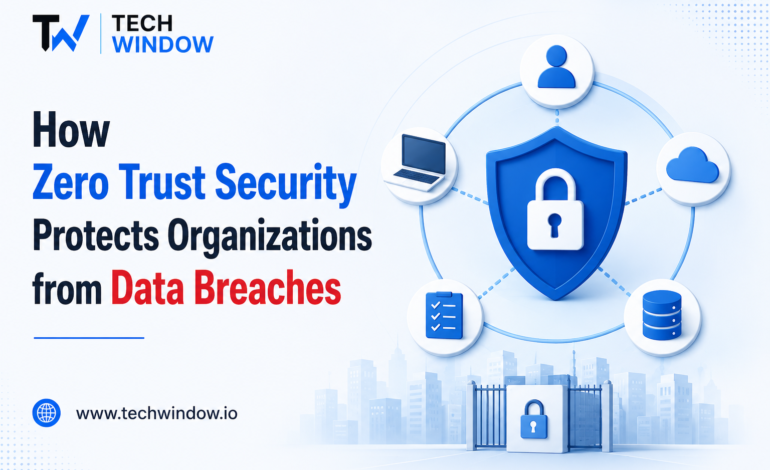
How Zero Trust Security Protects Organizations from Data Breaches

The threat landscape in the cyber world is rapidly changing. Security models are failing to keep up with the adoption of cloud computing, remote working, mobile devices and digital transformation by organisations. The data breaches are more prevalent, expensive and complex, impacting businesses of all sizes.
To tackle these problems, organizations are increasingly turning to Zero Trust Security, a cutting-edge cybersecurity approach that aims to reduce risk and access vulnerabilities.
While traditional security methods generally rely on the assumption that users and devices within a network are trusted, Zero Trust has a simple yet powerful principle:
“Never Trust, Always Verify.”
Tech Window‘s guide will cover what Zero Trust Security is, how it works, why it’s important and how it can help organizations protect themselves from the high cost of a data breach.
What Is Zero Trust Security?
Zero Trust Security is a cybersecurity model where all users, devices, applications and network connections must be continuously verified before being granted access to resources.
The Zero Trust philosophy doesn’t place trust in users because it assumes there is a threat both inside and outside the corporate network.
All access requests should be authenticated, authorized and continually validated.
This method can greatly minimize the risk of unwanted entry and leaks.
Why Traditional Security Models Are No Longer Enough
Traditional cyber security uses a perimeter defense strategy.
After being connected to the network via a firewall or VPN, users can be granted access to systems and data that are extensive.
There are a number of risks which arise due to this model:
- Insider threats
- Stolen credentials
- Compromised devices
- Lateral movement by attackers
- Cloud security gaps
These vulnerabilities are often used by modern attackers after they have been in to gain further access.
Zero Trust can mitigate such risks by continuously verifying trust.
How Zero Trust Security Works
Zero Trust Security is based on several key principles.
Verify Every User
Every user must prove their identity before accessing resources.
Organizations often use:
- Multi-Factor Authentication (MFA)
- Biometric verification
- Single Sign-On (SSO)
- Identity management systems
This helps prevent unauthorized access even if passwords are compromised.
Verify Every Device
Devices connecting to the network must meet security requirements.
Organizations validate:
- Device health
- Security patches
- Antivirus status
- Operating system compliance
Untrusted devices may be denied access.
Apply Least Privilege Access
Users receive only the permissions necessary to perform their jobs.
This minimizes the damage that can occur if an account becomes compromised.
Continuous Monitoring
Access decisions are continuously evaluated.
Security systems monitor:
- User behavior
- Login activity
- Device status
- Network traffic
Suspicious activity triggers additional verification or access restrictions.
Micro-Segmentation
Networks are divided into smaller security zones.
This limits an attacker’s ability to move laterally across systems after gaining access.
Common Causes of Data Breaches
Organizations face numerous cybersecurity threats.
Some of the most common causes include:
Phishing Attacks
Cybercriminals trick employees into revealing credentials or sensitive information.
Weak Passwords
Poor password practices make accounts easier to compromise.
Insider Threats
Employees or contractors may intentionally or accidentally expose data.
Unsecured Devices
Compromised laptops, smartphones, and IoT devices create entry points for attackers.
Cloud Misconfigurations
Improper cloud settings can expose sensitive data to the public internet.
Zero Trust addresses many of these risks through strict access controls and continuous verification.
How Zero Trust Prevents Data Breaches
Stops Unauthorized Access
Even if attackers steal credentials, they must pass additional verification steps.
Limits Lateral Movement
Micro-segmentation prevents attackers from freely moving through the network.
Protects Sensitive Data
Access controls ensure only authorized users can view critical information.
Detects Suspicious Activity Faster
Continuous monitoring helps identify threats in real time.
Reduces Insider Risks
Employees only receive access to the systems they genuinely need.
Secures Remote Work Environments
Zero Trust protects users regardless of their location or device.
This is particularly important as hybrid work models continue to grow.
Key Technologies Supporting Zero Trust
There are various technologies that enable organizations to do Zero Trust Security.
Multi-Factor Authentication (MFA)
MFA is a verification process that will need multiple methods before access is allowed.
Identity and Access Management (IAM)
IAM systems control identities and permissions of users.
Endpoint Security
Defends devices that interface with an organization’s network.
Security Information and Event Management (SIEM)
Gathers and processes security events as they happen.
Zero Trust Network Access (ZTNA)
Offers secure access to applications without compromising the entire network.
Behavioral Analytics
Uses AI and machine learning to identify unusual user activity.
Benefits of Zero Trust Security
Stronger Data Protection
Even if attackers are able to get into the system initially, sensitive information is kept protected.
Reduced Attack Surface
Organizations restrict opportunities for exploiters of vulnerabilities in cybercrime.
Improved Regulatory Compliance
Zero Trust helps support compliance with regulations such as:
- GDPR
- HIPAA
- PCI DSS
- ISO 27001
Better Visibility
Security teams gain greater insight into users, devices, and network activity.
Enhanced Remote Security
Employees can work securely from any location.
Industries Benefiting from Zero Trust
Healthcare
Maintains confidentiality of patient data.
Financial Services
Helps to prevent fraud and unauthorized account access.
Government Agencies
Protects sensitive infrastructure and information.
Retail and E-Commerce
Protects customer payment information.
Technology Companies
Safeguards intellectual property and customer data.
Challenges of Implementing Zero Trust
The implementation of Zero Trust can be challenging yet very effective.
Legacy Systems
Modern authentication methods might not be supported by older systems.
Complex Deployments
Implementation will need to be well planned and integrated.
User Resistance
Allowing extra security may seem cumbersome to employees up front.
Cost Considerations
May need to acquire new security technologies.
Even with these difficulties, the security can be long-term, with the benefits far outweighing the costs.
Zero Trust Security vs Traditional Security
| Feature | Traditional Security | Zero Trust Security |
|---|---|---|
| Trust Model | Trust Inside Network | Verify Everyone |
| Authentication | One-Time Login | Continuous Verification |
| Access Control | Broad Access | Least Privilege |
| Network Design | Perimeter-Based | Micro-Segmented |
| Threat Detection | Limited | Continuous Monitoring |
| Remote Work Security | Moderate | Strong |
This comparison highlights why Zero Trust Security has become a preferred cybersecurity strategy for modern organizations. By continuously verifying users, devices, and access requests, Zero Trust significantly reduces the risk of unauthorized access and data breaches compared to traditional perimeter-based security models.
The Future of Zero Trust Security
The more cyber attacks grow, the more Zero Trust will be adopted.
Future trends include:
AI-Powered Security
Threat detection and response will benefit from Artificial Intelligence.
Cloud-Native Zero Trust
Organizations will expand Zero Trust to multi-cloud environments.
Continuous Authentication
The process of identity verification will become even more dynamic and context aware.
Advanced Behavioral Analytics
Anomaly detection will be improved with machine learning.
Integration with Cyber Resilience Strategies
Zero Trust will become an integral part of enterprise cybersecurity strategies.
Best Practices for Implementing Zero Trust
Organizations should:
- Deploy Multi-Factor Authentication
- Enforce least privilege access
- Continuously monitor network activity
- Segment networks effectively
- Protect endpoints and devices
- Perform routine security checks
- Train employees on cybersecurity awareness
These practices will help make Zero Trust Security as effective as possible.
Conclusion
Data breaches continue to pose significant risks for organizations worldwide. Traditional security models are no longer sufficient in an environment where users, devices, and applications operate across multiple locations and cloud platforms.
Zero Trust Security is proactive, always questioning each user, device and access. By implementing robust authentication, least privilege access, micro-segmentation and constant monitoring, organizations can significantly lower the risks of data breaches.
Zero Trust Security is a critical cybersecurity approach that we believe businesses need to embrace in 2026 and beyond to safeguard sensitive data and enhance their security stance.At Tech Window, Zero Trust Security stands out as one of the most impactful strategies businesses can implement to protect sensitive data and fortify their security posture in 2026 and beyond.