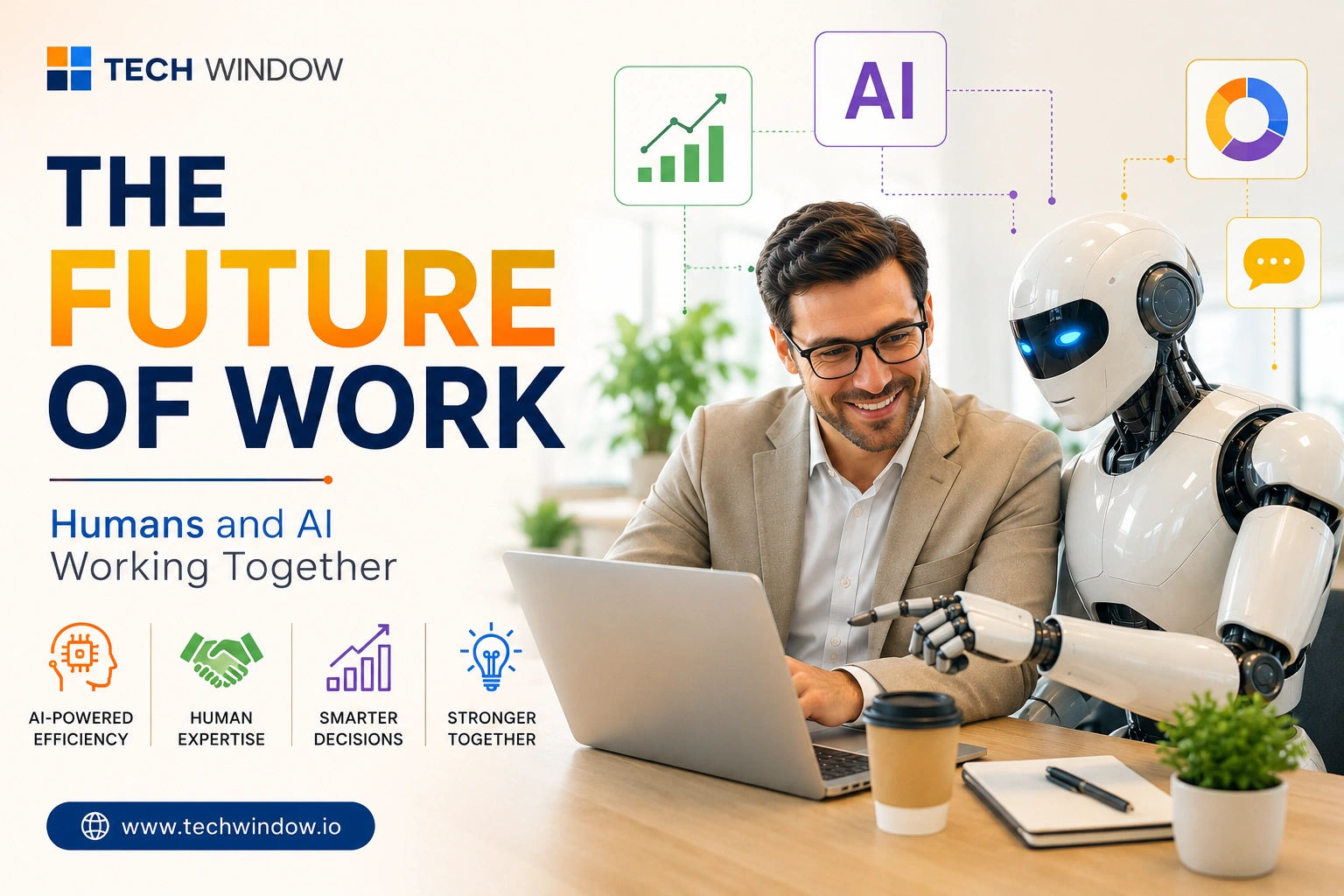
The Future of Work: Humans and AI Working Together

The work environment is in one of its most significant changes in today’s history. The era of Artificial Intelligence (AI) in movies and research labs is over; AI is now a reality in everyday life. In the modern era, AI is assisting businesses in automating processes, making better decisions, providing improved customer experiences, and promoting productivity in various industries.
With the rise of AI, one question that’s still on the lips of many is:
Will AI replace human workers?
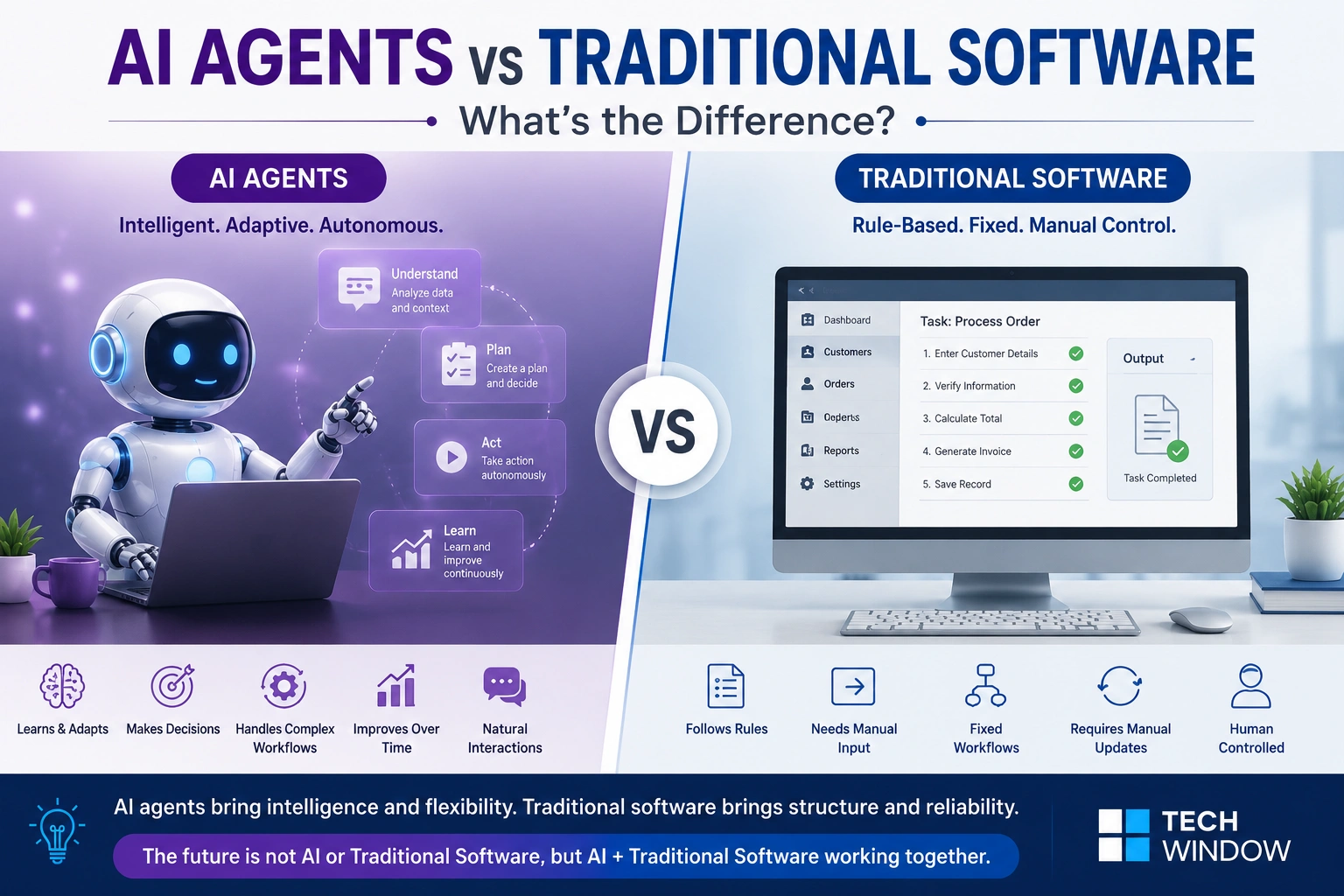
The future is not one of man versus machine, AI is already transforming the way work is done. However, it is about the collaboration between humans and AI to build smarter, more efficient and innovative workplaces.
AI’s speed, automation, and analytical power are complementing the human touch of creativity and emotional intelligence, presenting organizations around the world with a compelling opportunity for growth.
In this Tech Window guide, we’ll delve into the future of work with the collaboration of humans and AI, its advantages, the hurdles that organizations encounter, and tips for professionals to successfully prepare for an AI era.
Understanding Human-AI Collaboration
Human-AI collaboration refers to the partnership between people and Artificial Intelligence systems to achieve better outcomes than either could accomplish alone.
Rather than replacing employees, AI serves as a powerful assistant that supports workers by:
- Automating repetitive tasks
- Processing large volumes of data
- Providing actionable insights
- Improving operational efficiency
- Supporting decision-making
Humans remain responsible for:
- Creativity
- Strategic planning
- Leadership
- Innovation
- Relationship building
- Ethical decision-making
This collaborative approach is becoming the foundation of modern workplaces.
Why Businesses Are Embracing AI
Organizations face increasing pressure to improve productivity while remaining competitive.
AI helps businesses:
Increase Efficiency
AI eliminates repetitive tasks that consume time, freeing workers to work on more value-added activities.
Reduce Operational Costs
Automation decreases manual workloads and optimizes the use of resources.
Improve Decision-Making
AI can process large volumes of data and detect patterns that might not be noticed by humans.
Enhance Customer Experiences
AI tools are used in businesses to offer individual suggestions and speed up support services.
Support Innovation
AI-driven insights enable businesses to discover new opportunities and speed up product development.
The advantages are pushing AI adoption forward across sectors at a fast pace.
How AI Is Transforming the Workplace
Automating Repetitive Tasks
Many workplace activities involve repetitive processes that consume valuable time.
Examples include:
- Data entry
- Scheduling
- Invoice processing
- Report generation
- Customer inquiries
AI can perform these tasks quickly and accurately.
Data Analysis and Insights
Organizations generate enormous amounts of data daily.
AI can:
- Analyze trends
- Detect anomalies
- Forecast outcomes
- Generate business insights
This helps leaders make more informed decisions.
Customer Service Automation
AI-powered chatbots and virtual assistants provide:
- 24/7 support
- Instant responses
- Personalized interactions
Human agents can then focus on complex customer issues.
Workflow Optimization
AI helps streamline operations by identifying inefficiencies and recommending improvements.
Benefits of Humans and AI Working Together
Increased Productivity
AI takes care of repetitive work, leaving employees time for strategic and creative tasks.
This greatly enhances productivity overall.
Better Decision-Making
AI provides data-driven recommendations, while humans contribute judgment, experience, and context.
Together, they make stronger decisions.
Enhanced Innovation
AI can help develop concepts and ideas, followed by human evaluation, the process of which can be enhanced by AI, and then finalized into innovative solutions.
Improved Accuracy
AI minimizes the risk of mistakes in repetitive tasks, which enhances the uniformity and reliability of work.
Greater Employee Satisfaction
This will help to reduce repetitive work among employees, allowing them to concentrate on more meaningful and engaging activities.
Leanr More :- AI vs Human Programmers
Industries Leading Human-AI Collaboration
Healthcare
AI assists healthcare professionals by:
- Analyzing medical images
- Identifying potential diagnoses
- Reviewing patient records
Doctors remain responsible for treatment decisions and patient care.
Finance
Financial institutions use AI for:
- Fraud detection
- Risk assessment
- Market analysis
Human experts oversee strategy and compliance.
Manufacturing
Smart factories use AI-powered systems for:
- Quality control
- Predictive maintenance
- Production optimization
Human workers supervise operations and solve complex problems.
Cybersecurity
AI helps security teams:
- Detect threats
- Monitor network activity
- Identify suspicious behavior
Security analysts investigate incidents and develop response strategies.
Marketing
Marketers use AI to:
- Analyze customer behavior
- Optimize campaigns
- Generate content ideas
Human creativity continues to drive successful marketing strategies.
Tasks AI Handles Best
Artificial Intelligence excels in areas that involve:
Data Processing
AI can analyze vast amounts of information in seconds.
Pattern Recognition
Machine learning systems identify trends and anomalies with high accuracy.
Automation
AI efficiently performs repetitive and predictable tasks.
Predictive Analytics
Organizations use AI to forecast future outcomes based on historical data.
These capabilities allow businesses to operate more efficiently.
Skills Humans Continue to Lead
Despite rapid advancements, several human skills remain difficult for AI to replicate.
Emotional Intelligence
The ability to feel and to relate is still a uniquely human ability.
Creativity
People have a talent for thinking creatively, for developing new ideas and innovative approaches.
Critical Thinking
Judgment is frequently necessary when solving complex problems, as one is not always based on data analysis.
Leadership
Human leadership is the key ingredient in managing teams, inspiring employees, and building organization culture.
Ethical Decision-Making
Moral, social and cultural issues are taken into account in making decisions by humans.
Adaptability
Individuals are able to respond appropriately to unexpected situations and/or changes in the environment.
These skills will be even more useful in the future workplace.
Challenges of Human-AI Collaboration
Workforce Reskilling
Employees must learn new skills to work effectively with AI technologies.
Privacy Concerns
Organizations must protect sensitive information used by AI systems.
AI Bias
Poorly trained AI models can produce unfair or inaccurate outcomes.
Employee Resistance
Some workers fear job displacement and may resist AI adoption.
Overreliance on Automation
Businesses should maintain human oversight to avoid excessive dependence on AI systems.
Addressing these challenges is essential for successful AI integration.
New Jobs Created by AI
While AI automates certain tasks, it is also creating entirely new career opportunities.
Examples include:
- AI Engineers
- Machine Learning Specialists
- Prompt Engineers
- AI Ethics Consultants
- Data Scientists
- Automation Experts
- AI Product Managers
- AI Security Specialists
The demand for AI-related skills continues to grow worldwide.
Humans vs AI in the Workplace
Human-AI collaboration works best when each focuses on its strengths.
| Feature | Artificial Intelligence | Humans |
| Speed | Extremely Fast | Moderate |
| Data Analysis | Excellent | Good |
| Creativity | Limited | Excellent |
| Emotional Intelligence | Low | Excellent |
| Strategic Thinking | Limited | Strong |
| Adaptability | Moderate | High |
| Relationship Building | Weak | Excellent |
| Ethical Judgment | Limited | Strong |
This comparison highlights why the future workplace depends on collaboration rather than competition.
What the Workplace of 2030 May Look Like
The next decade is expected to bring major workplace changes.
AI Assistants for Every Employee
Many professionals may have AI-powered assistants helping with daily tasks.
Personalized Workflows
AI will customize workflows based on individual preferences and productivity patterns.
Continuous Learning
Employees will regularly update their skills as technology evolves.
Hybrid Human-AI Teams
Organizations will increasingly combine human expertise with AI capabilities.
Smarter Decision-Making
AI-powered analytics will support faster and more informed business decisions.
The workplace of 2030 is likely to be more intelligent, connected, and collaborative than ever before.
How Professionals Can Prepare for the Future
To thrive in an AI-driven world, professionals should:
Learn AI Tools
Understanding AI technologies can improve productivity and career opportunities.
Develop Soft Skills
Communication, leadership, and emotional intelligence remain highly valuable.
Improve Digital Literacy
Technology skills will become increasingly important across industries.
Embrace Lifelong Learning
Continuous education will help workers adapt to evolving workplace demands.
Focus on Creativity and Innovation
Human creativity will continue to differentiate successful professionals.
Conclusion
Artificial Intelligence is transforming the way organizations operate, but it is not replacing the human workforce. Instead, AI is becoming a powerful partner that helps employees work smarter, faster, and more efficiently.
The future of work will be defined by collaboration between humans and AI. While machines excel at automation, data analysis, and repetitive tasks, humans continue to lead in creativity, leadership, emotional intelligence, and strategic thinking.
Organizations that successfully combine human strengths with AI capabilities will be best positioned to innovate, grow, and compete in the digital economy.
At Tech Window, we believe the future belongs not to humans or AI alone, but to those who learn how to work together effectively.