


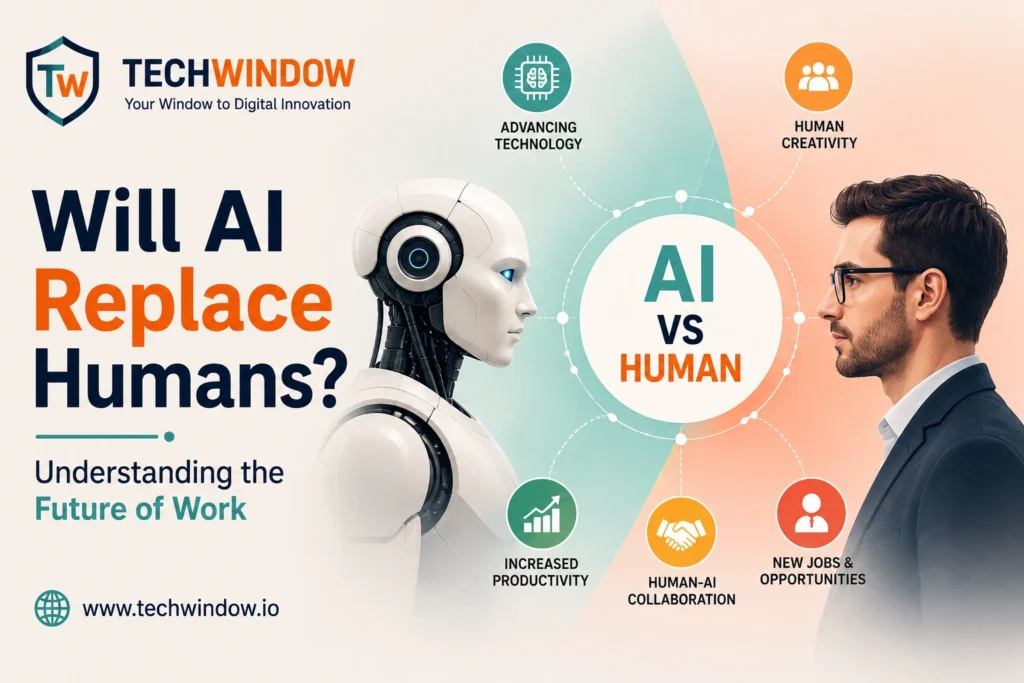
It is now possible to have a conversation about Artificial Intelligence (AI) and not sound like a futurist. It is already impacting industries, making tasks automated and even changing the way businesses work. AI is being integrated into workplaces in a multitude of ways, ranging from AI chatbots and virtual assistants to self-driving vehicles and sophisticated data analysis.
With the rapid advancement of AI, there’s one thing everyone wants to know in every industry:
Will AI replace humans?
The answer is easy and complicated. Although AI will automate a lot of work and change the nature of the job, it is not expected to eliminate humans from the process. Rather, AI will reshape work, generate jobs, and reinvent jobs.
In this guide from Tech Window, we’ll take a look at how AI affects employment, what roles might be more in danger, which skills will continue to be in demand, and what the workforce of the future may look like in an AI world.
Understanding Artificial Intelligence in the Workplace
Artificial Intelligence is the capability of computer systems to execute tasks that normally need human intelligence.
These tasks include:
- Learning from data
- Problem-solving
- Pattern recognition
- Language understanding
- Decision-making
- Automation
AI helps businesses enhance efficiency, cut down on costs, and draw insights from vast data sets.
AI is currently being used in:
- Customer service
- Healthcare
- Finance
- Manufacturing
- Marketing
- Education
- Cybersecurity
- Human resources
It’s becoming more popular and is transforming careers around the world.
Why People Fear AI Replacing Humans
Automation fears aren’t new.
In the past, new technologies have taken the place of and created opportunities for work.
AI is different from the previous technologies, though, as it can execute cognitive functions in addition to physical ones.
A lot of employees are concerned about:
- Job displacement
- Reduced employment opportunities
- Wage pressure
- Increased automation
- Skills becoming obsolete
These concerns are understandable, especially as AI systems become more capable.
Jobs Most Likely to Be Affected by AI
AI is particularly effective at handling repetitive, predictable, and data-driven tasks.
There are a number of careers that will be majorly affected.
Data Entry and Administrative Roles
Large amounts of information can be quickly and accurately analyzed by AI.
AI can process large amounts of information quickly and accurately.
Tasks such as:
- Data entry
- Scheduling
- Document management
- Basic reporting
Automation is gaining ground in the growing number of cases where these tasks are being performed.
Customer Support
Many of the common customer queries are being dealt with by AI-powered chatbots and virtual assistants.
They can provide:
- Instant responses
- 24/7 support
- Automated ticket management
Manufacturing and Logistics
Automation and robotics continue to transform production environments.
AI systems help optimize:
- Inventory management
- Quality control
- Supply chain operations
Basic Content Generation
AI tools can generate:
- Product descriptions
- Social media captions
- Basic articles
- Marketing copy
But, human oversight is crucial for quality and originality.
Financial Processing
AI can automate:
- Invoice processing
- Fraud detection
- Risk assessment
- Transaction monitoring
This decreases man-hours and enhances efficiency.
Jobs AI Is Unlikely to Replace
While many professions have evolved rapidly, these professions still have some skills that are uniquely human.
Healthcare Professionals
Doctors, nurses, and therapists rely on:
- Empathy
- Human interaction
- Ethical judgment
- Complex decision-making
AI can help but can’t completely replace these jobs.
Leadership and Management
Business leaders must:
- Inspire teams
- Build relationships
- Navigate uncertainty
- Make strategic decisions
They need to be emotionally intelligent and experienced to be able to take on these responsibilities.
Creative Professionals
Creative fields often involve:
- Original thinking
- Storytelling
- Artistic expression
- Innovation
Though AI can produce content, human creativity is still essential to stand out.
Skilled Trades
Electricians, Plumbers, Technicians, and Construction Workers have very versatile jobs working in the physical environment.
There are many of these positions that haven’t been easily automated.
Educators
AI cannot replace mentorship, communication, and tailored guidance—these are the elements that are inherent in teaching.
Human Skills AI Cannot Easily Replace
The future workforce will increasingly value uniquely human abilities.
Emotional Intelligence
The ability to understand emotions, build trust and manage relationships are still human strengths.
Creativity
People are great at their ability to come up with new ideas and innovative solutions.
Critical Thinking
Humans still need to be able to make complex reasoning decisions and strategic analysis.
Ethical Decision-Making
Moral, social and cultural issues are taken into consideration by humans in making decisions.
Adaptability
Individuals are easily adaptable and can change their environment and situation quickly.
Leadership
The roles of guiding teams and managing the culture of the organization are still very human.
AI as a Workplace Assistant
AI is not a substitute for human beings, but a strong assistant in the workplace.
This is referred to as AI-Augmented Work.
Examples include:
Software Development
Developers use AI to:
- Generate code
- Detect bugs
- Automate testing
Marketing
Marketers use AI for:
- Campaign analysis
- Content suggestions
- Customer insights
Healthcare
Doctors use AI to:
- Analyze medical images
- Support diagnoses
- Review patient data
Cybersecurity
Security teams leverage AI for:
- Threat detection
- Incident response
- Risk analysis
AI supplements working humans in both scenarios in increasing productivity.
Benefits of AI in the Workplace
Increased Productivity
AI can perform repetitive tasks quicker than humans.
Cost Savings
Automation helps reduce operational expenses.
Better Decision-Making
AI is able to process massive amounts of information and detect trends efficiently.
Improved Customer Experiences
Organizations have the ability to offer more efficient and personalized services.
Enhanced Innovation
Employees can engage in strategic and creative tasks, rather than routine tasks.
Challenges of an AI-Driven Workforce
Workforce Reskilling
Staff need to be upskilled and to meet new job demands.
Ethical Concerns
Organizations must address issues such as:
- Bias in AI systems
- Privacy protection
- Responsible AI use
Job Displacement
As automation takes over some roles may go away.
Governments and businesses need to facilitate the transitions of the workforce.
Security Risks
AI systems can become targets for cyberattacks and misuse.
Overreliance on Automation
Relying solely on AI without human intervention is not an ideal solution for organizations.
New Jobs Created by AI
While AI may eliminate some tasks, it is also creating entirely new career opportunities.
Examples include:
- AI Engineers
- Machine Learning Specialists
- AI Ethics Consultants
- Prompt Engineers
- Data Scientists
- AI Product Managers
- Automation Specialists
- Cybersecurity Analysts
The demand for AI-related skills continues to grow across industries.
AI vs Humans: Strengths Comparison
| Feature | Artificial Intelligence | Humans |
|---|---|---|
| Speed | Extremely Fast | Moderate |
| Data Processing | Excellent | Limited |
| Creativity | Limited | High |
| Emotional Intelligence | Low | Excellent |
| Adaptability | Moderate | High |
| Critical Thinking | Limited | Strong |
| Innovation | Limited | Strong |
| Strategic Decision-Making | Limited | Excellent |
| Relationship Building | Weak | Excellent |
This comparison shows that Artificial Intelligence and Humans excel in different areas. While AI offers unmatched speed, automation, and data processing capabilities, humans continue to lead in creativity, emotional intelligence, strategic thinking, and relationship building. The future of work is likely to be driven by collaboration between humans and AI rather than competition.
The Future of Work
The workplace of tomorrow will be collaborative between humans and AI.
Key trends include:
Human-AI Collaboration
AI tools will be used by workers more and more to boost productivity and decision making.
Continuous Learning
Labor should be periodically re-skilled.
Growth of AI-Powered Industries
New jobs and job roles will be created that will revolve around the new technologies of AI.
Increased Automation
Common jobs will continue to be automated.
Focus on Human-Centered Skills
Creativity, communication, leadership and emotional intelligence will come in even more useful.
Frequently Asked Questions (FAQs)
Will AI replace all jobs?
No. AI will automate certain tasks, but many jobs will continue to require human skills and judgment.
Which jobs are most at risk from AI?
Data entry, administrative support, basic customer service, and repetitive operational roles are among the most vulnerable.
What skills will remain valuable in the AI era?
Creativity, emotional intelligence, communication, leadership, and critical thinking.
Will AI create new jobs?
Yes. AI is creating new opportunities in technology, data science, cybersecurity, automation, and AI management.
How can workers prepare for AI?
Continuous learning, digital skills development, and adaptability will help professionals remain competitive.
How Workers Can Prepare for the Future
To remain competitive in an AI-driven economy, professionals should:
- Learn digital skills
- Understand AI technologies
- Develop critical thinking abilities
- Improve communication skills
- Embrace lifelong learning
- Focus on creativity and innovation
Adaptability will be one of the most important career skills in the coming years.
Conclusion
While Artificial Intelligence has drastically changed the way work is done, it doesn’t seem to be going to take the place of humans. AI is perfect for automation, data analysis, and repetitive tasks, but human creativity, emotional intelligence, critical thinking, and leadership skills are invaluable.
The future of work isn’t one person versus another.The future of work isn’t “man versus AI.” It’s, instead, concerning humans and AI functioning collectively to attain greater productivity, innovation, and business achievements.
We at Tech Window believe the best way to leverage AI is as a tool, not a threat, and that’s the approach of the professionals who are most likely to be successful in the future workforce.


