


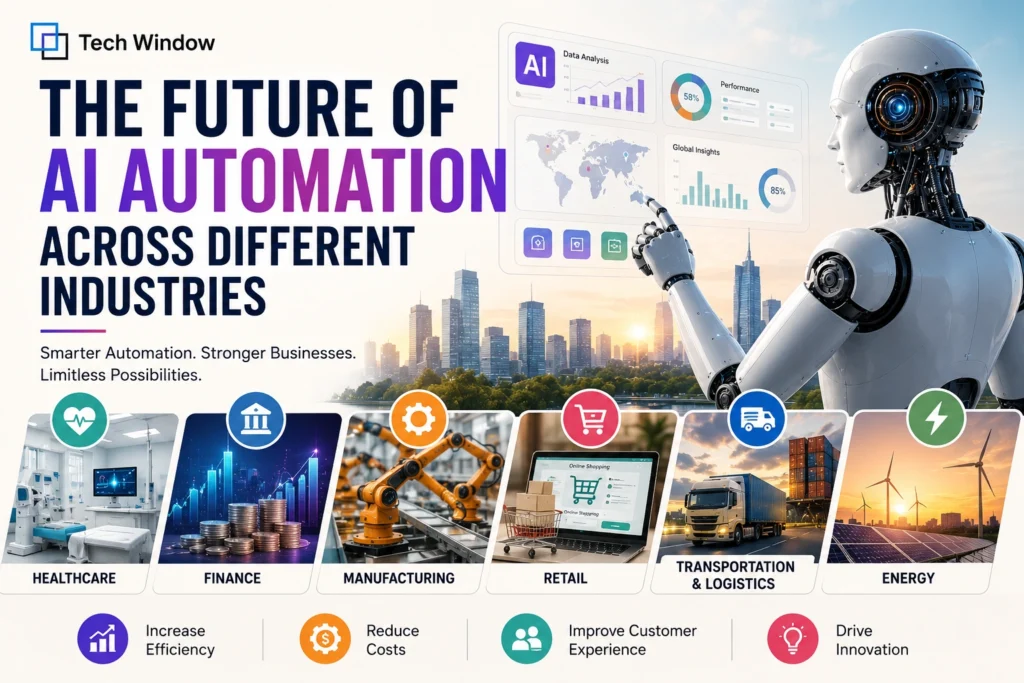
Artificial Intelligence (AI) has evolved from a futuristic concept into a practical business tool that is reshaping industries worldwide. Organizations are increasingly adopting AI automation to improve efficiency, reduce operational costs, and enhance customer experiences. From healthcare and finance to manufacturing and retail, AI-powered solutions are revolutionizing the way businesses operate.
As technology continues to advance, the future of business automation will become even more intelligent, adaptive, and impactful. Companies that embrace these innovations early will gain a significant competitive advantage in the rapidly evolving digital economy.
In this article, we explore how AI automation is transforming different industries and what the future holds for businesses embracing this powerful technology.
At Tech Window, we closely monitor emerging technology trends and innovations shaping the future of business. One of the most transformative developments is AI automation, which is helping organizations improve efficiency, reduce costs, and accelerate digital transformation across industries.
What Is AI Automation?
AI automation combines artificial intelligence technologies with automated systems to perform tasks with minimal human intervention. Unlike traditional automation, which follows predefined rules, AI-powered systems can learn from data, make decisions, identify patterns, and improve over time.
Examples of AI automation include:
- Virtual assistants and chatbots
- Automated customer support
- Predictive analytics
- Smart manufacturing systems
- AI-powered cybersecurity solutions
- Autonomous vehicles
- Intelligent supply chain management
These technologies are helping businesses streamline operations and increase productivity across various sectors.
Why AI Automation Is Growing Rapidly
Several factors are driving the adoption of AI automation:
Increased Data Availability
Businesses generate enormous amounts of data every day. AI systems analyze this data quickly and accurately, providing valuable insights for decision-making.
Rising Demand for Efficiency
Companies are under constant pressure to improve productivity while reducing costs. AI automation helps organizations achieve both objectives simultaneously.
Technological Advancements
Modern machine learning algorithms, cloud computing, and powerful processors have made AI solutions more accessible and affordable.
Enhanced Customer Expectations
Consumers now expect faster responses, personalized experiences, and 24/7 support. AI automation enables businesses to meet these demands effectively.
AI Automation in Healthcare
Healthcare is one of the industries experiencing the most significant transformation through AI automation.
Faster Diagnostics
AI-powered systems can analyze medical images and detect diseases with remarkable accuracy. This helps healthcare professionals diagnose conditions earlier and improve patient outcomes.
Predictive Healthcare
Machine learning algorithms can identify potential health risks before they become severe, enabling preventive treatment strategies.
Administrative Automation
Hospitals and clinics use AI automation to manage:
- Patient scheduling
- Billing processes
- Medical record management
- Insurance claims processing
This reduces administrative burdens and allows healthcare workers to focus more on patient care.
Future Outlook
In the coming years, AI-driven healthcare solutions may assist in personalized medicine, robotic surgeries, and advanced drug discovery processes.
AI Automation in Finance
The financial sector has embraced AI automation to improve accuracy, security, and customer service.
Fraud Detection
AI systems can analyze millions of transactions in real time and identify suspicious activities more effectively than traditional methods.
Automated Trading
Investment firms use AI algorithms to analyze market trends and execute trades based on complex data patterns.
Customer Support
AI chatbots provide instant responses to customer inquiries and help resolve common banking issues around the clock.
Risk Assessment
Financial institutions use AI to evaluate creditworthiness and assess lending risks more accurately.
Future Outlook
Future AI automation in finance will likely include advanced financial planning tools, hyper-personalized banking services, and more sophisticated fraud prevention systems.
AI Automation in Manufacturing
Manufacturing has become one of the biggest beneficiaries of AI-powered automation.
Predictive Maintenance
AI systems monitor equipment performance and predict failures before they occur, reducing downtime and maintenance costs.
Smart Factories
Connected machines and AI software enable factories to optimize production processes automatically.
Quality Control
Computer vision systems inspect products in real time and identify defects with high precision.
Supply Chain Optimization
AI helps manufacturers manage inventory, forecast demand, and improve logistics efficiency.
Future Outlook
Next-generation manufacturing facilities will rely heavily on autonomous systems, robotics, and AI-driven decision-making.
AI Automation in Retail
Retail businesses are leveraging AI automation to improve customer experiences and operational efficiency.
Personalized Shopping Experiences
AI analyzes customer behavior and purchase history to recommend products tailored to individual preferences.
Inventory Management
Retailers use AI to forecast demand and optimize stock levels, reducing waste and improving profitability.
Smart Customer Service
AI chatbots and virtual assistants provide instant support and answer customer questions.
Dynamic Pricing
AI systems can adjust prices based on market demand, competitor pricing, and customer behavior.
Future Outlook
Retailers will continue integrating AI-powered technologies to create highly personalized and seamless shopping experiences.
AI Automation in Transportation and Logistics
Transportation and logistics companies are using AI automation to improve efficiency and reduce operational costs.
Route Optimization
AI systems calculate the most efficient delivery routes, reducing fuel consumption and delivery times.
Fleet Management
Organizations use AI to monitor vehicle performance and schedule maintenance proactively.
Autonomous Vehicles
Self-driving technology continues to evolve and may eventually transform transportation industries worldwide.
Warehouse Automation
AI-powered robots can manage inventory, sort products, and prepare shipments with minimal human intervention.
Future Outlook
The logistics industry will increasingly depend on AI-driven automation for faster and more reliable deliveries.
AI Automation in Customer Service
Customer service has been transformed by intelligent automation technologies.
AI Chatbots
Modern chatbots handle customer inquiries instantly and can resolve many issues without human assistance.
Sentiment Analysis
AI tools analyze customer feedback and identify satisfaction levels, helping businesses improve services.
Voice Assistants
Virtual assistants provide support through voice interactions, creating more convenient customer experiences.
Future Outlook
AI-powered customer service systems will become more conversational, personalized, and capable of handling complex interactions.
AI Automation in Cybersecurity
As cyber threats become more sophisticated, AI automation is playing a critical role in protecting digital assets.
Threat Detection
AI systems monitor network activity and identify suspicious behavior in real time.
Automated Response
Security platforms can automatically respond to certain threats before they cause significant damage.
Risk Assessment
AI helps organizations identify vulnerabilities and prioritize security improvements.
Future Outlook
AI-powered cybersecurity solutions will become essential for protecting businesses against increasingly advanced cyberattacks.
Benefits of AI Automation Across Industries
Organizations adopting AI automation can enjoy numerous benefits:
Increased Productivity
AI systems perform repetitive tasks faster and more accurately than humans.
Reduced Costs
Automation reduces labor-intensive processes and minimizes operational expenses.
Better Decision-Making
AI provides data-driven insights that support smarter business decisions.
Improved Customer Experience
Businesses can deliver faster, more personalized services through AI-powered solutions.
Scalability
AI systems can handle growing workloads without significant increases in staffing requirements.
Challenges Businesses Must Address
Despite its advantages, AI automation presents several challenges.
Data Privacy Concerns
Organizations must ensure responsible handling of sensitive customer information.
Workforce Adaptation
Employees need training to work effectively alongside AI technologies.
Implementation Costs
Initial investments in AI infrastructure can be substantial.
Ethical Considerations
Businesses must address concerns related to bias, transparency, and accountability in AI systems.
Know More :- What Businesses Need to Know
The Future of AI Automation
The future of AI automation looks incredibly promising. Advances in machine learning, natural language processing, robotics, and cloud computing will continue expanding the capabilities of intelligent systems.
Key trends expected to shape the future include:
- Hyper-automation across business operations
- AI-powered decision intelligence
- Autonomous business processes
- Advanced predictive analytics
- Intelligent digital assistants
- Human-AI collaboration models
- Industry-specific AI solutions
As organizations continue embracing digital innovation, AI automation will become a central component of business strategy across nearly every industry.
Conclusion
AI automation is no longer a technology reserved for large corporations. Businesses of all sizes are adopting intelligent automation solutions to improve efficiency, enhance customer experiences, and remain competitive in a rapidly evolving marketplace.
From healthcare and finance to manufacturing, retail, logistics, and cybersecurity, AI is transforming industries in unprecedented ways. As business automation technologies continue to advance, organizations that invest in AI-driven solutions today will be better positioned to succeed in the future.
The next generation of AI automation will not simply replace repetitive tasks—it will empower businesses to make smarter decisions, innovate faster, and unlock new opportunities for growth in the digital age.
The future of AI automation is filled with opportunities for businesses willing to embrace innovation. At Tech Window, we believe that organizations investing in AI, business automation, and digital transformation today will be better prepared for tomorrow’s challenges and opportunities.


